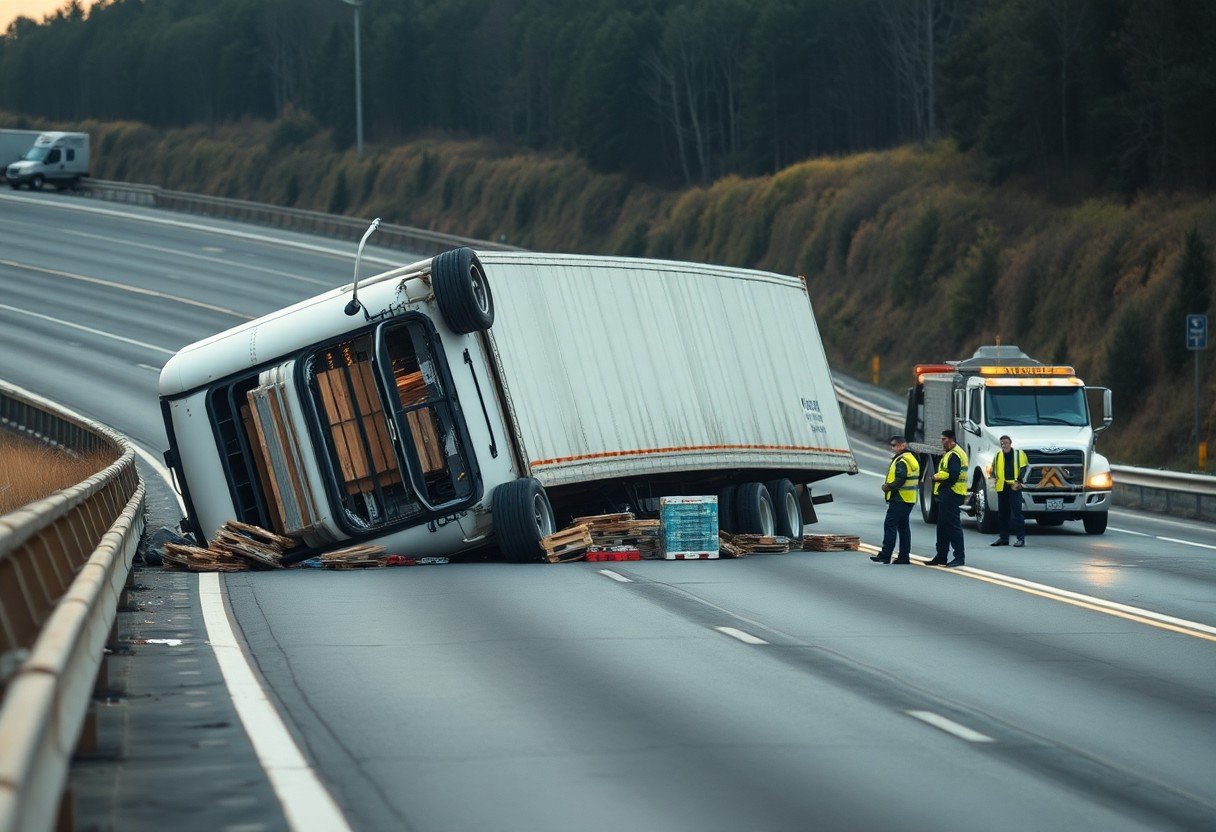
It’s important you understand that truck accident cases differ from typical collisions due to federal safety regulations, multiple potentially liable parties (drivers, employers, manufacturers), and specialized evidence such as electronic logging devices and maintenance records; knowing these distinctions helps you manage liability issues, insurance negotiations, and the need for expert investigation to protect your rights and pursue full compensation.
Key Takeaways:
- Multiple potentially liable parties: driver, carrier, shipper, maintenance providers, and manufacturers.
- Federal regulations (FMCSA) and hours-of-service/ELD rules create specific duties and admissible evidence.
- Essential evidence differs: ELD/black box data, logbooks, inspection/maintenance records, and cargo/load documentation require early preservation.
- Collisions tend to be more severe; commercial policies and higher insurance limits introduce coverage complexity.
- Claims involve corporate defenses, apportionment of fault, and technical legal issues-cases often demand specialized investigation and counsel.
Understanding Truck Accidents
You face evidence and legal issues far more complex than in passenger-vehicle crashes: trucks can weigh up to 80,000 pounds, have large blind spots and far longer stopping distances, and their operations are governed by FMCSA rules like the 11-hour driving limit and 14-hour duty window. Investigations routinely pull ELD logs, maintenance records and cargo manifests to tie liability to drivers, carriers, shippers or maintenance providers.
Types of Truck Accidents
You encounter several distinct collision patterns that change analysis and damages: rear-end and underride crashes often produce catastrophic injuries, jackknifes and rollovers relate to cargo shift or braking on slick roads, and wide-right turn collisions involve complex sightline and turning-radius issues in urban settings.
- Rear-end collisions (often brake or following-distance issues)
- Underride crashes (passenger vehicle slides beneath trailer)
- Jackknife and rollover incidents (loss of control from sudden braking or load shift)
- Wide-turn and sideswipe collisions in intersections
- Recognizing how each type impacts evidence, injury patterns and liability allocation is imperative
| Rear-end | Often from distracted driving, tailgating, or brake failure |
| Underride | Trailer rear impact with severe intrusion due to lack of guards |
| Jackknife | Abrupt braking or slick pavement causes trailer to swing |
| Rollover | High center of gravity, improper loading, or evasive steering |
| Wide-turn | Truck swing radius in tight urban turns, poor signaling or blind spots |
Common Causes of Truck Accidents
You will most often see driver fatigue, HOS violations, distracted driving, improper cargo securement, mechanical failures (brakes/tires), and poor maintenance as proximate causes. Enforcement tools like ELDs and post-crash inspections frequently reveal log falsification or overdue repairs that point to carrier-level liability.
When you dig deeper into cases, patterns emerge: carriers that push tight delivery schedules increase average driver on-duty pressure, and FMCSA limits (11 hours driving, 14-hour duty window, 60/70-hour weekly caps) exist precisely because fatigue triples reaction-time risk. Mechanical factors are equally common-worn tires and overdue brake work repeatedly appear in DOT inspection reports-and cargo-related problems (improperly tarped or blocked loads) cause sudden shifts that trigger jackknifes or rollovers. Your investigations should prioritize ELD downloads, maintenance logs, pre-trip inspection reports, and witness GPS/camera data to build a timeline tying these causes to specific actors.
Legal Framework for Truck Accident Cases
You navigate a mixed legal landscape where federal FMCSA rules, the Code of Federal Regulations (49 CFR), and state tort law intersect; FMCSA standards often control safety issues while state courts handle negligence claims. Federal jurisdiction is common when interstate commerce or diversity exists, and statutes of limitation typically range from 2-3 years depending on state. You must track both regulatory violations and common-law duties to build a complete claim.
Regulations Governing Commercial Trucks
You should focus on FMCSA mandates like hours-of-service (11-hour driving limit, 14-hour duty window, 30-minute break rule), the ELD mandate implemented in 2017, cargo securement rules under 49 CFR 393, and mandatory inspection/maintenance and drug-testing protocols. Violations of these specific rules-such as falsified logs or missing maintenance records-provide strong evidence of negligence and often shift settlement dynamics in your favor.
Liability Issues in Truck Accidents
You will often face multiple defendants: the driver, the carrier under respondeat superior, shippers/loaders for improper loading, maintenance shops, and manufacturers for defective components. Courts apply theories like negligent hiring/training, negligent maintenance, and product liability; independent-contractor defenses are common but can fail if the carrier controlled operations. High-severity cases frequently result in seven-figure settlements or verdicts when multiple liabilities align.
You can leverage objective data to prove liability: ELD records, hours-of-service violations, dashcam or in-cab video, maintenance logs, DVIRs, roadside inspection reports, and the carrier’s SMS safety score. For example, an ELD showing repeated 14-hour days plus a missing maintenance entry for worn brake linings creates a powerful causation narrative. Discovery targeting contracts and load manifests often reveals shipper or loader responsibility for overloaded or unsecured freight.
Differences Between Truck and Passenger Vehicle Accidents
When you compare collisions, trucks often change the calculus: an 80,000-pound tractor-trailer versus a 4,000-pound car transfers vastly more force, federal rules like FMCSA hours-of-service and mandatory ELDs apply to carriers, and multiple parties-driver, carrier, shipper, broker-can share liability. For a deeper legal comparison see Truck Accident Cases v. Car Accident Cases: Why They Are Completely Different.
Severity of Injuries
You face a much greater risk of catastrophic harm in truck collisions: crushing forces and intrusion often cause spinal cord injuries, traumatic brain injury, or amputations. Given the weight differential-up to 20 times a typical car-medical costs and long-term care commonly exceed six figures, and outcomes frequently require multi-year rehabilitation and specialized prosthetics or home modifications.
Insurance Considerations
You should expect commercial policies and corporate defense: federal minimum liability limits run from $750,000 (general freight) up to $5,000,000 for certain hazardous cargos, so insurers and carriers bring coordinated legal teams and fast evidence preservation. That means claims involve adjusters, coverage disputes, and early negotiation tactics aimed at limiting payouts.
You also need to act quickly on evidence and procedure: obtain ELD data, driver qualification files, maintenance logs, and post-crash drug/alcohol test results within statutory windows. Carriers often set reserves and hire firms immediately, discovery spans interstate regulation issues, and settlements for serious injuries commonly enter six- or seven-figure ranges once fault and full economic losses are documented.
The Role of Trucking Companies in Accidents
When you dig into many wreck files, the carrier’s policies and supervision are central evidence: dispatch decisions, pressure to meet delivery windows, and maintenance budgets all shape risk. Federal HOS limits-11 hours driving after 10 hours off and a 14-hour work window-are commonly cited, and carriers who ignore them expose you to preventable fatigue crashes. Insurance underwriters and juries look at CSA scores, maintenance logs, and dispatch records to link company practices to your client’s injuries.
Company Policies and Maintenance
Company maintenance programs and recordkeeping speak loudly in litigation: federal rules require periodic and annual inspections and driver pre-trip checks, and missing entries or skipped repairs (brake lines, lighting, tires) often tip liability toward the carrier. You should expect to find service invoices, DOT inspection reports, and telematics data; carriers using computerized maintenance and predictive analytics typically show fewer vehicle defects, while those with chronic Vehicle Maintenance BASIC failures face higher settlement exposure.
Driver Training and Responsibility
Carrier hiring, training, and supervisory policies determine whether your driver had the skills to avoid a crash: since Feb 7, 2022, entry-level drivers must complete certified ELDT before obtaining a CDL, and carriers must maintain drug/alcohol testing, pre-employment checks, and hours-of-service compliance monitoring. You’ll want training records, in-cab coaching notes, and trip-by-trip supervision logs to assess whether inadequate training or lax oversight contributed to the event.
Digging deeper, focus on specific training elements: defensive driving, cargo securement, backing and coupling procedures, skid control, and fatigue management. If you obtain behind-the-wheel sign-off sheets, in-ride instructor notes, and telematics event videos, you can show gaps-such as lack of supervised highway time or missing classroom modules-that correlate with lane departures, jackknifes, or improper load restraint, strengthening your case that the carrier’s training program failed to mitigate predictable risks.
Navigating Compensation Claims
As you pursue compensation, focus on liability, damages, and available insurance; many commercial carriers carry policy limits between $1 million and $5 million, while hazmat carriers often carry higher coverage. Prioritize preserving evidence-ELD logs, cargo bills, maintenance records-and calculate losses: medical bills, lost wages, future care. Statutes of limitations commonly run 2-3 years, so file early to protect your claim.
Types of Damages Recoverable
You can recover economic damages (medical expenses, lost earnings), non-economic damages (pain and suffering), and in some cases punitive damages when gross negligence is proven. Typical settlements for moderate-severity truck cases range from $100,000 to over $1 million depending on liability and injuries. Assume that you’ll need receipts, expert testimony, and wage records to prove these amounts.
- Medical bills and future care
- Lost wages and diminished earning capacity
- Property damage to vehicle and cargo
- Pain and suffering and emotional distress
- Punitive damages for gross negligence
| Economic Damages | Medical costs, rehabilitation, prescription, $120k example |
| Lost Earnings | Past wages + future earning capacity estimates |
| Property Damage | Vehicle repair/replacement, cargo loss |
| Non-Economic | Pain, suffering, loss of consortium |
| Punitive | Only for reckless conduct, jury-awarded |
How to File a Claim
Start by reporting the crash to the carrier and its insurer within days, preserve evidence, and assemble a demand package with medical records, wage statements, and a liability summary; insurers typically respond with either an offer or a request for more documentation. If negotiations stall, you’ll file a civil complaint-expect settlement talks to take months and litigation 12-24 months in complex truck cases.
Subpoena ELD logs (ELD mandate effective December 2017), driver qualification files, dispatch records, and maintenance histories early; retain an accident reconstructionist and vocational economist for serious injuries. If the carrier asserts the driver was an independent contractor, you’ll need contracts and dispatch evidence to show control and establish vicarious liability.
Legal Representation in Truck Accident Cases
When you face a commercial crash, legal representation shifts the investigation and claims strategy: lawyers secure ELD/black box data, subpoena driver logs and maintenance records, and coordinate with reconstruction experts. Fast action matters because many states have a 2-3 year statute of limitations and perishable electronic evidence; engaging counsel early often increases settlement leverage and preserves key proof for trial.
Importance of Specialized Attorneys
You want attorneys who know FMCSA rules, hours-of-service violations, and carrier liability nuances; specialized firms often handle 100+ truck cases annually and routinely work with accident reconstructionists, toxicologists, and vocational experts. That depth lets you challenge carrier defenses, decode ELD downloads, and quantify long-term damages with credible expert testimony.
Factors to Consider When Hiring a Lawyer
When you choose counsel, assess trial experience with 18-wheeler cases, case volume (aim for firms with 50+ truck matters), access to reconstruction and medical experts, and fee terms-contingency fees typically run 33-40%. Also verify their track record on multi-defendant litigation, ability to advance costs, and familiarity with spoliation and FMCSA discovery demands.
- Ask for examples of verdicts or settlements in truck cases and the firm’s role in each.
- Confirm they can obtain ELD downloads, maintenance logs, and driver employment files quickly.
- Review client references and bar records for disciplinary history and case outcomes.
- The ability to advance litigation costs and coordinate medical care for you.
For more depth, request sample pleadings, the names of reconstructionists they use, and a timeline for discovery-firms that routinely litigate against major carriers understand insurer strategies and typically resolve complex cases in 12-24 months. Also confirm communication frequency so you know how often you’ll get case updates and what to expect at each stage.
- Local trial experience: how many truck trials have they taken to verdict in your county or state.
- Network strength: access to engineers, ELD analysts, and life-care planners for long-term damages.
- Their plan for client communications and frequency of status reports.
Final Words
Hence you should understand that truck accident cases differ from typical collisions because of federal regulations, multiple liable parties, specialized evidence, and higher stakes for damages; when you pursue a claim, your strategy must account for industry standards, black box data, and insurer tactics to protect your compensation and ensure thorough investigation.
FAQ
Q: Why are truck accident cases different from car crashes?
A: Commercial trucks differ in size, weight, and stopping distance, so collisions produce more severe damage and complex injury patterns. Trucks operate under federal hours-of-service, maintenance, and cargo-loading rules that create additional standards of care and regulatory violations that can be used as evidence. Commercial operations also generate extensive documentary records (logs, dispatch records, ELD/ECM data) and often involve multiple potentially liable parties, making investigations and litigation more technically and factually complicated than typical passenger-vehicle crashes.
Q: Who can be held liable in a commercial truck crash?
A: Liability can extend beyond the driver to include the motor carrier, trucking company, vehicle owner, cargo loader or shipper, maintenance or repair shops, and vehicle or component manufacturers. Legal theories often include negligent hiring or retention, negligent supervision or training, vicarious liability for employees, negligent maintenance, and product liability. Determining employment status, contract relationships, and which entity controlled the vehicle or trip are central to identifying defendants.
Q: What types of evidence are unique or most important in truck cases?
A: Key evidence often includes electronic logging device (ELD) files, event data recorder (EDR)/ECM downloads, driver logbooks, dispatch and load manifests, maintenance and inspection records, drug and alcohol testing results, cell-phone and GPS data, surveillance or dash-cam footage, weigh-station and trip records, and cargo-loading documentation. Early preservation letters and prompt forensic downloads are critical because carriers may overwrite data or alter records; expert reconstruction using the electronic and physical evidence is typically necessary to establish speed, braking, driver actions, and vehicle condition.
Q: How do insurance issues and settlement dynamics differ in truck cases?
A: Trucking companies usually carry higher liability limits, umbrella policies, or self-insured retentions, which affects settlement valuation and negotiation strategies. Multiple insurance layers and coverage disputes (e.g., leased drivers, brokered loads) are common. Carriers and insurers may conduct fast investigations and make early low offers to limit exposure; plaintiffs often need specialized counsel to value catastrophic claims, pursue all responsible insurers, and litigate coverage issues to access higher limits or excess coverage.
Q: What immediate steps should an injured person take after a commercial truck collision?
A: Obtain medical care and document all injuries and treatment. Preserve evidence by photographing the scene, vehicle damage, road markings, and injuries, and gathering witness contact information. Report the crash but avoid detailed recorded statements without counsel. Request and preserve records (police report, carrier name, driver identity, license plate). Send a preservation/preservation-of-evidence letter to the carrier and consult an attorney experienced in truck cases quickly to secure downloads, prevent spoliation, and evaluate regulatory violations and all potential defendants.