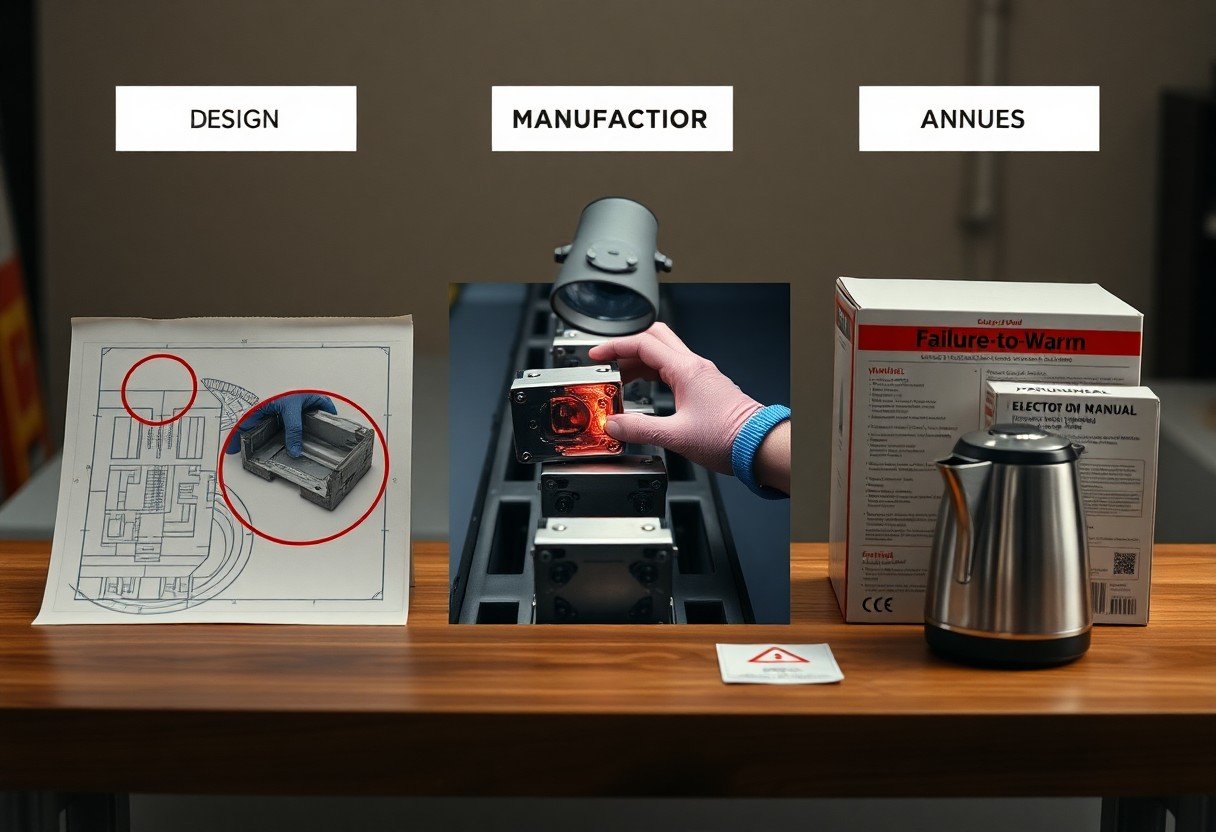
Most product liability disputes turn on whether a defect stems from design, manufacturing, or a failure-to-warn, and you should understand how each category shifts legal strategy and proof. A design defect means the product’s intended blueprint is unsafe; a manufacturing defect means the product deviated from that blueprint during production; a failure-to-warn defect means warnings or instructions were inadequate. Knowing these distinctions shapes your risk assessment and claims approach.
Key Takeaways:
- Design defect: flaw in the product’s blueprint or intended design that makes every unit unreasonably dangerous; liability often requires showing a feasible safer alternative or that the product fails consumer-expectation or risk‑utility tests.
- Manufacturing defect: departure from the intended design during production that causes a particular unit to be dangerous; plaintiff must show the product differed from the designer’s plan and that the deviation caused the injury.
- Failure-to-warn (marketing) defect: inadequate instructions or warnings about known or foreseeable risks; liability focuses on whether the absence or inadequacy of warnings made the product unreasonably dangerous and whether a proper warning would have prevented the harm.
- Timing and proof differences: design defects exist before manufacture, manufacturing defects arise during production, and warning failures concern post‑design communication; proof strategies and evidence differ accordingly (e.g., alternative design evidence for design defects, inspection/testing for manufacturing defects, expert testimony and notice for warning claims).
- Legal consequences and defenses: remedies include damages, corrective action, recalls or redesigns; common defenses include product misuse, compliance with industry standards or state‑of‑the‑art, and arguing causation or that adequate warnings were provided.
Understanding Design Defects
When you assess design defects, think of flaws built into a product’s blueprint that make every unit unreasonably dangerous. They’re systemic, not random, and often precipitate wide recalls-classic examples include the 1970s Ford Pinto fuel-tank placement and the Takata airbag inflator design that led to a global recall affecting over 100 million vehicles. Engineers, regulators, and courts focus on the original specification, embedded choices, and whether a safer, economically viable alternative existed.
Definition and Examples
You identify a design defect when the hazard stems from the intended design rather than a manufacturing slip; every unit carries the risk. Examples range from the Ford Pinto’s rear-fuel tank that increased post-collision fire risk to the Dalkon Shield IUD’s design linked to pelvic infections. Regulatory data shows design defects often trigger product-line recalls and replacement programs because redesign, not single-unit correction, is required.
Legal Implications
When you pursue a design-defect claim you face distinct legal routes: strict liability, negligence, and breach of warranty. Courts apply either the consumer-expectation test or the risk-utility test, the latter asking whether a feasible alternative design existed and its cost-benefit. Expect to rely heavily on expert engineering analyses-FMEA, finite element analysis, and prototype testing-to prove defectiveness and harm; juries frequently weigh those technical exhibits heavily.
Different jurisdictions shift burdens: many U.S. courts require proof by a preponderance of the evidence and allow either consumer-expectation or risk-utility frameworks-California often favors risk-utility under Barker; the Restatement (Third) endorses risk-utility. You must preserve design files, test reports, and change logs because spoliation harms defenses. Large design-defect cases commonly become class actions or mass torts, prompting recalls and settlements that frequently run into the tens or hundreds of millions.
Exploring Manufacturing Defects
When defects originate on the production line, you’ll see failures tied to process control, raw-material variance, and inspection gaps; these faults typically appear as isolated batches or systematic run failures rather than product-intent problems, and they demand different discovery methods-statistical sampling, batch traceability, and supplier audits-to pinpoint root causes and quantify exposure.
Characteristics and Causes
You should watch for spikes in scrap rate, out-of-spec tolerances, or intermittent failures that correlate with specific lots, shifts, or suppliers; common causes include tooling wear, contamination, improper curing or heat cycles, incorrect assembly torque, and inadequate incoming inspection, with defect rates often jumping from 0.01-0.1% to 1-5% when controls fail.
Case Studies
You can learn a lot from major recalls: they show how small process deviations scale into mass failures, how long it takes to trace batch-level causes, and how regulatory and litigation exposure grows once injuries are reported-examples below illustrate scale, timelines, and root-cause patterns.
- Takata airbag inflators – over 60 million inflators recalled worldwide; linked to at least 24 deaths and hundreds of injuries; root cause: ammonium nitrate propellant degradation due to moisture and aging in manufacturing/storage (recalls 2008-2019).
- Samsung Galaxy Note7 batteries – ~2.5 million units recalled in 2016 after battery cell manufacturing defects caused overheating and fires; recall and discontinuation affected global replacement programs and brand trust.
- Firestone ATX/ATX II tires (Ford Explorer) – ~6.5 million tires recalled in 2000 following widespread tread separations; outcome showed interaction of manufacturing flaws, product use, and inadequate QC leading to severe accident rates.
You’ll notice patterns across these cases: contamination or material instability during production often produced delayed failures; manufacturing variability clustered by lot or supplier; and incomplete traceability prolonged mitigation, increasing recall scope and costs.
- Takata (2008-2019) – recall scale: tens of millions of inflators across >60 million vehicles; manufacturing factor: propellant chemistry sensitive to humidity; legal/repair costs exceeded billions.
- Samsung Note7 (2016) – recalled ~2.5 million units worldwide; manufacturing defects in battery cell separators led to internal shorting; total program loss and market impact measured in hundreds of millions to billions of dollars.
- Philips CPAP/ventilator foam (2021) – ~3.5 million devices recalled for degradable sound-abatement foam; manufacturing and material-selection issues produced particulate/chemical concerns prompting large-scale remediation.
- Peloton Tread (2021) – recalled ~125,000 treadmills after reports including one child fatality and multiple injuries; investigation pointed to design-use interactions and production verification gaps in safety-critical assemblies.
Analyzing Failure-to-Warn Defects
You assess failure-to-warn by mapping known hazards to how actual users encounter the product: foreseeability, severity, and likelihood drive whether a warning was necessary and adequate. You examine placement, font size, language, pictograms, and repeat instructions across packaging, manuals, and online content. You also compare against industry standards (e.g., ASTM, FDA guidance) and prior incidents-an unlabeled chemical concentrate that caused burns after misuse is the kind of factual pattern courts scrutinize.
Importance of Adequate Warnings
You rely on warnings to alter user behavior and allocate risk when redesign isn’t feasible. You expect prominence, plain language, and actionable steps-quantified limits (e.g., “Do not exceed 5 kg”), clear prohibitions, and multilingual copies for diverse users. You factor in known misuse scenarios: consumer power tools need torque limits and PPE guidance, while medical devices require clinician-oriented instructions and patient leaflets to reduce errors and liability exposure.
Legal Precedents
You should anchor analyses in case law: Wyeth v. Levine (2009) allowed state-law failure-to-warn claims against drug makers despite FDA approval; PLIVA v. Mensing (2011) limited liability for generic manufacturers; Riegel v. Medtronic (2008) found preemption for PMA-approved devices; Buckman Co. v. Plaintiffs’ Legal Committee (2001) constrained fraud-on-the-FDA torts. Courts weigh foreseeability, adequacy, causation, and whether feasible alternative warnings existed.
You will need expert evidence-label comprehension studies, human-factors testing, epidemiology, and feasibility analyses-to show an alternative warning would likely have changed behavior and prevented harm. You should collect contemporaneous risk assessments, internal safety memos, and post-market reports; juries often rely on demonstrative evidence and quantitative estimates of risk reduction when deciding causation and damages under state standards like Restatement (Third) of Torts §2(b).
Comparing Design, Manufacturing, and Failure-to-Warn Defects
You should parse these defects by when and how the unsafe condition arises: design defects affect the blueprint, manufacturing defects affect an individual unit, and failure-to-warn defects involve inadequate instructions or labeling; see California Design vs. Manufacturing Defects – Neer the Twain … for a jurisdictional example that illustrates proof and remedy differences.
Quick Comparison
| Aspect | How it affects outcomes |
| Timing | Design: inherent pre-production; Manufacturing: post-production unit-level; Failure-to-warn: post-sale information gap |
| Proof | Design: safer alternative/risk-utility or consumer-expectation tests; Manufacturing: deviation records, batch testing, inspection logs |
| Evidence | Design: design specs, risk analyses (ISO 14971), prototypes; Manufacturing: QC reports, metrology, lot numbers |
| Scope of impact | Design: entire product line; Manufacturing: specific units or lots; Failure-to-warn: users who relied on warnings/instructions |
Similarities and Differences
You’ll find overlap-each theory can produce strict liability or negligence exposure depending on jurisdiction-but differences matter: design suits often need a risk‑utility balance or a safer‑feasible‑alternative showing, manufacturing claims require demonstrating deviation from design via QC/batch evidence, and failure‑to‑warn claims hinge on foreseeability and causation tied to labeling and instructions.
Impact on Liability
You must tailor your strategy because liability drivers change: design defects can trigger classwide recalls and product‑line damages, manufacturing defects often lead to targeted remedies and replacement of affected lots, while failure‑to‑warn claims can produce compensatory and, if knowledge is shown, punitive damages tied to what your warnings omitted.
More specifically, courts may apply different standards-some use the consumer‑expectation test for design, others prefer risk‑utility balancing-so your proof plan should include design history files, ISO risk assessments, manufacturing inspection logs, and postmarket complaint trends; in practice, strong traceability (lot codes, test certificates) reduces exposure on manufacturing claims while thorough labeling history mitigates failure‑to‑warn risk.
Prevention Strategies
Adopt a layered prevention strategy that combines safer design, robust manufacturing controls and clear warnings. Use DFMEA/PFMEA and standards like ISO 14971 (medical) or ISO 26262 (automotive) to identify hazards early. You should enforce supplier quality agreements, statistical process control and in‑line inspections to catch deviations before assembly. Finally, implement post‑market surveillance-track field failures, returns and near‑misses-and close the loop with corrective actions and design updates.
Best Practices in Design and Manufacturing
Integrate human factors and iterative usability testing into early design sprints so you reduce misuse via affordances and guards. Apply redundancy and fail‑safe features where single failures cause harm, and tighten tolerances for safety‑critical dimensions. On the manufacturing side, require process capability (Cp/Cpk) targets above 1.33, use poka‑yoke, maintain calibrated equipment, and keep a documented design history and supplier control plan.
Effective Warning Systems
Design warnings to be seen and understood: use ANSI Z535 signal words and ISO 7010 pictograms, place labels in primary sightlines, and use minimum font sizes with high contrast. You should tailor language to the user population, include concise action steps, and ensure durability against abrasion, UV and chemicals. Combine text, pictograms and signal words to improve immediate comprehension in multi‑lingual contexts.
Validate warnings with representative user testing-20-30 participants often reveals comprehension gaps-and iterate until comprehension rates meet your targets. Also test in situ: simulate lighting, noise and glove use; ensure audible alarms are at least 10 dB above ambient noise or meet workplace standards, and deploy redundant modalities (visual, audible, haptic) for high‑risk functions. Document test results, error rates and rationale in the labeling file for legal defensibility.
Industry Case Analysis
You’ve seen how high-profile recalls map to defect types. Takata’s ammonium nitrate inflators produced shrapnel, affected over 100 million airbags worldwide and were tied to at least 28 deaths. Boeing’s MCAS design failures caused two crashes that killed 346 people and led to a 20‑month global grounding of the 737 MAX. Ford’s Pinto decisions in the 1970s prompted landmark litigation.
High-Profile Cases
You can parse failures: Takata exposes manufacturing and supplier-control breakdowns-OEMs issued recalls exceeding 100 million inflators and paid multi‑billion‑dollar settlements. Boeing shows how a design-control gap and inadequate pilot information escalates risk. Ford Pinto demonstrates the perils of design choices weighed against litigation costs instead of hazard elimination, a lesson in risk evaluation and corporate governance.
Lessons Learned
You should treat these cases as operational checklists: strengthen supplier audits, mandate DFMEA and PFMEA during design, run human‑factors testing, and maintain rigorous post‑market surveillance with defined complaint and failure-rate triggers. Regulators tightened oversight after these events, so proactive documentation of warnings, mitigations and test data reduces exposure to failure‑to‑warn and design-defect claims.
Implement specific controls: require design verification protocols, 100% inspection for safety‑critical components when feasible, and statistical sampling plans aligned with ISO 2859. You should contractually enforce supplier quality agreements, perform quarterly on‑site audits, and use telemetry or field data analytics to detect anomalies early. Also draft clear, user‑tested warnings with readability metrics and retain decision records; courts often focus on documented alternatives considered and why warnings were chosen over design changes.
Final Words
So you must distinguish design defects (flaws in the intended product concept affecting all units), manufacturing defects (errors in production affecting individual units), and failure-to-warn defects (inadequate instructions or warnings about risks); each carries different legal standards, evidence requirements, and remedies, so align your testing, quality controls, documentation, and communications to manage liability, support litigation, or prevent harm.
FAQ
Q: What is a design defect, a manufacturing defect, and a failure-to-warn defect?
A: A design defect exists when the product’s intended plan or blueprint is inherently unsafe even if built exactly as intended; liability often depends on a risk-utility or consumer-expectation test. A manufacturing defect occurs when a product departs from its intended design during production or assembly, making that particular unit more dangerous than others of the same model. A failure-to-warn defect arises when the manufacturer fails to provide adequate instructions or warnings about non-obvious risks associated with foreseeable use, including foreseeable misuse.
Q: How do courts evaluate a design-defect claim?
A: Courts typically apply either a risk-utility test-balancing the design’s benefits against its risks and considering the feasibility and cost of a safer alternative-or a consumer-expectation test-asking whether the ordinary consumer would find the product unreasonably dangerous. Many jurisdictions allow both tests. Plaintiffs often must show a feasible, safer alternative design that would have reduced or prevented the harm without impairing the product’s utility or making it unreasonably expensive.
Q: What proof is required to establish a manufacturing defect?
A: Plaintiffs must show the specific product that caused injury deviated from the manufacturer’s intended design and that the deviation proximately caused the injury. Evidence can include physical inspection of the product, expert testimony, comparison with non-defective units, and production records. Because manufacturing defects involve a faulty unit rather than the design as a whole, plaintiffs usually do not need to propose an alternative design.
Q: When does a failure-to-warn claim succeed and what makes a warning adequate?
A: A failure-to-warn claim succeeds if the plaintiff shows the manufacturer knew or should have known of a non-obvious, foreseeable risk, failed to warn or provide adequate instructions, and that absence caused the injury. Adequate warnings are clear, specific, conspicuous, and provide actionable guidance for avoiding the hazard; they must reach the intended user and address foreseeable misuse. Regulatory compliance can be relevant but is not always dispositive-preemption or statutory immunities may apply in limited circumstances.
Q: What remedies are available and what common defenses do manufacturers raise for each defect type?
A: Remedies typically include compensatory damages (medical costs, lost earnings, pain and suffering), restitutionary relief, injunctive orders, and in some cases punitive damages and recall costs. Common defenses: for design defects, manufacturers argue state-of-the-art design, cost-benefit justification, or that no feasible safer alternative existed; for manufacturing defects, defenses include lack of causation, post-sale alteration, or supplier blame; for failure-to-warn claims, defenses include adequate warning, unforeseeable misuse by the plaintiff, learned intermediary doctrine in pharmaceuticals, and compliance with regulatory labeling requirements or industry standards. Comparative fault principles and assumption-of-risk may reduce or bar recovery across defect types.