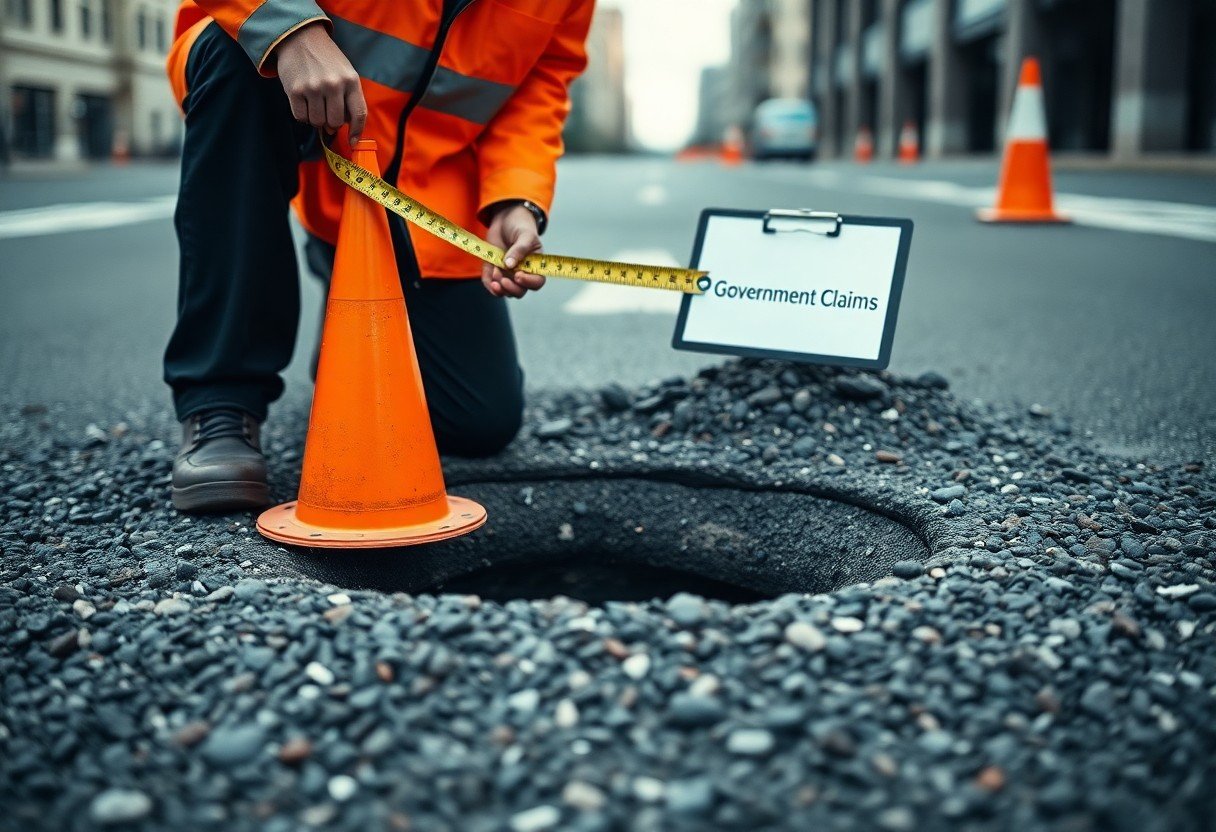
Most drivers encounter potholes or loose gravel unexpectedly, and knowing when your damages may trigger a government claim helps you protect your rights. This post explains how liability, notice requirements, and evidence standards apply to claims against municipalities so you can assess whether to file, gather the right documentation, meet filing deadlines, and pursue compensation effectively.
Key Takeaways:
- Government liability can arise when a public entity had actual or constructive notice of a dangerous road condition (pothole or loose gravel) and failed to repair or warn within a reasonable time.
- Most jurisdictions impose strict pre‑suit procedures and short notice deadlines (written claim or notice of claim); missing these procedural requirements can bar recovery.
- Sovereign or discretionary‑function immunity may protect governments for planning or policy decisions, while negligent maintenance, inspection, or failure to warn remains actionable.
- Successful claims require proof of the defect’s location and condition, causation linking the defect to the loss, and measurable damages; photographs, prior complaints, repair logs, and witness statements strengthen a case.
- Comparative fault and mitigation matter: the plaintiff’s own conduct can reduce recovery, and timely vehicle inspection/repair and preservation of evidence improve claim prospects.
Understanding Road Hazards
You encounter potholes and loose gravel in predictable patterns: after heavy rains, freeze-thaw cycles, utility cuts, or recent grading. Potholes can develop within weeks and gravel sections deteriorate rapidly under high traffic, so you should track where hazards repeat. Municipal departments often log hundreds of defect reports yearly in urban areas; when you note recurring sites, that pattern can inform maintenance schedules and later claims about notice or negligence.
Definition of Potholes
Potholes are surface voids formed when water penetrates pavement, freezes, thaws, and traffic dislodges the weakened material; they commonly range from a few inches to over a foot across and several inches deep. If you hit a 6-8 inch pothole at speed, you can expect rim damage, tire blowouts, or suspension misalignment-repairs that routinely run into the hundreds or low thousands of dollars per vehicle in real-world claims.
Risks Associated with Gravel Roads
Loose aggregate reduces traction and increases stopping distance, so you face skidding and loss-of-control risks, especially at 35-55 mph common on rural routes. You also risk rock chips to paint and windshields: stones kicked up by a passing truck can shatter glass or dent body panels, turning a short encounter with loose gravel into costly collision or damage claims.
Additionally, motorcycles and bicycles are disproportionately affected because a single loose stone can cause wheel deflection or a slide; commercial vehicles can throw gravel into following traffic, creating secondary hazards. When you document skid marks, stone patterns, or photos of loose shoulders after grading, those details strengthen any later account of how the gravel contributed to the incident.

Legal Framework for Government Liability
When you pursue a claim for potholes or gravel, liability is governed by a mix of federal FTCA rules and state statutes that set duties, notice windows, and damage caps. Often you must present an administrative claim within two years under the FTCA or meet state notice deadlines of 30-180 days. Courts weigh statutory duties to maintain roads, repair schedules, and whether the act was policy-level or operational; those factors determine whether you can overcome immunity and reach damages or settlement.
Negligence Standards
You must show the government owed a duty, breached it, and that breach caused your injury. Proof often relies on maintenance logs, 311 complaints, repair schedules, and photographs showing a defective surface existed long enough to be noticed. Juries consider foreseeability and constructive notice: if prior reports or a routine 30-60 day repair policy existed, you can argue the agency had sufficient notice and failed to act.
Government Immunity Exceptions
Immunity often blocks suits for discretionary policymaking, but exceptions arise when actions are ministerial or negligent in execution. Under the FTCA’s discretionary function exception and many state analogs, policy choices like funding priorities are shielded, while routine road repairs, inspection failures, or ignored repair orders can expose the agency. If you can tie the harm to a specific operational lapse, immunity is less likely to bar your claim.
Distinctions matter: Berkovitz v. United States frames the discretionary-function test by asking whether the challenged conduct involved judgment grounded in social, economic, or political policy. You can benefit when the act was a clear, ministerial duty-failing to fill a reported pothole within an agency’s posted 14-30 day repair window, for example-because courts then permit negligence claims despite broader immunities.
Reporting Road Hazards
When you spot a pothole or loose gravel, file a report with the local DOT or 311 system immediately; many cities offer apps or web forms and aim to address hazardous defects within 24-72 hours. Provide the precise location (GPS or nearest cross street), attach photos, and save the report number. If the condition poses an immediate public danger, call emergency services so responders can secure the scene while the DOT schedules repair.
Steps to Report Potholes
Start by noting exact location (GPS coordinates or nearest intersection), then measure diameter and depth-depth over about 2 inches (5 cm) frequently causes tire or rim damage. Photograph the hole from several angles with an object for scale, record date/time and weather, and upload everything via the municipality’s website, app, or 311 phone line. Keep the confirmation or ticket number and any email correspondence for later claims or follow-up.
Documenting Hazardous Conditions
Photograph hazards from multiple perspectives, include a ruler, coin, or tape measure for scale, and capture any missing signage or protective barriers; ensure images retain timestamp and GPS metadata. Note traffic patterns, light conditions, and names of witnesses with contact info. Preserve copies of all photos, videos, and communications in both cloud storage and local backup so you can produce consistent evidence if you later file a claim.
When collecting proof, use your phone’s location-enabled camera and screenshot the image metadata to link evidence to the scene. If safe, take a short video pan showing approach, hazards, and nearby markers; include a measured depth reading in the video. Obtain an itemized repair estimate and keep receipts for any emergency fixes. If someone is injured or vehicle damage is substantial, get a police report and file your municipality claim within its deadline-commonly between 90 days and one year.
Filing Claims Against Government Entities
Eligibility Criteria
You must show the roadway was under government control, your damage or injury resulted from a defect (pothole, loose gravel), and quantifiable losses exist-repair invoices, medical bills, or tow receipts. Statutory immunities and discretionary-act defenses vary by state; if the agency failed routine, ministerial maintenance you’re more likely to qualify than when the issue stems from policy or budgeting choices. Examples: New York requires prompt notice procedures; California often treats these as tort claims under Gov. Code requirements.
Claim Submission Process
You start by identifying the responsible agency-city public works, county road department, state DOT, or a federal agency-and submitting the prescribed written claim or notice with photos, repair estimates, receipts, police reports, and witness contact info. Deadlines matter: many places require notice within 30-90 days, California commonly uses a six‑month claim period, and federal FTCA claims must be presented within two years; send materials by certified mail or use the agency’s portal when available.
Agencies often provide a specific claim form (city claim form, state tort claim, or an SF‑95 for federal FTCA matters); use it and include date/time/location coordinates, vehicle damage estimates, and a clear causal statement. Avoid common errors: missing signatures, late filing, or vague damage descriptions. Agencies typically investigate within 30-120 days; under the FTCA you must present a claim and either await a decision or six months before filing suit, so track claim numbers and get written denials if needed.
Common Challenges in Claims
You will often face missing maintenance logs, unclear responsibility between county and state roads, and comparative-fault arguments that cut your recovery. Evidence gaps are common: municipalities routinely lack timely repair records or patched-area photos, so you must produce dashcam footage, timestamped photos, or witness statements. For example, if you’re found 20% at fault after hitting a pothole, your damages can be reduced by that percentage, making precise documentation and prompt notice crucial to maximize recovery.
Burden of Proof
You must prove duty, breach, causation, and damages by a preponderance of the evidence-meaning your version is more likely true than not. Concrete items that help: measurements of the defect (depth/diameter), repair invoices ($200-$1,500 commonly for tire/wheel repairs), photos with timestamps, witness affidavits, and traffic-maintenance logs showing notice or prior complaints. Expert inspection reports tying the defect to your loss often swing borderline claims in your favor.
Time Limitations for Filing
You typically face short notice windows and statutes of limitations: many jurisdictions require a formal notice of claim within 30-90 days and suit within 1-3 years. Missing the municipal notice deadline can bar your claim even if the statute of limitations for filing a lawsuit hasn’t run. Act quickly to preserve rights and avoid procedural dismissals that have defeated otherwise strong liability cases.
When preparing your notice, include the exact location (mile marker or GPS coordinates), date/time, vehicle plate, concise description of the defect, estimated damages, witness names, and attach photos and repair receipts. Keep original invoices and any police or tow reports. If emergency repairs were necessary, save receipts and document why immediate fixes were required. If you suspect a missed deadline, consult counsel promptly-some courts permit late filings only for exceptional reasons.
Case Studies and Precedents
You’ll find patterns in verdicts and settlements that show what evidence wins: prior notice to the municipality, maintenance logs, clear photos, and independent repair estimates. Below are concrete examples with years, outcomes, and dollar figures to help you assess your own claim strategy.
- Example 1 – Urban pothole strike (2017, Northeastern city): plaintiff showed 48 prior complaints; settlement $42,500 after demonstrable roadway neglect and emergency repair invoices.
- Example 2 – Gravel on highway shoulder (2019, state DOT case): commercial truck lost a wheel; jury awarded $110,000 citing failure to sweep debris despite weekly maintenance schedule.
- Example 3 – Tire blowout from unmarked sinkhole (2020, county road): claim denied when plaintiff missed 90‑day notice deadline; court cited statutory notice requirement and no contemporaneous photo evidence.
- Example 4 – Motorcycle crash from loose gravel (2018, small municipality): settlement $85,000 after helmet-cam footage and two prior service tickets were produced by the plaintiff.
- Further reading – comparative duties and liability factors: Who is Liable if a Road Hazard Causes a Car Accident?
Successful Claim Examples
You benefit most when you produce time-stamped photos, repair estimates, and records showing the municipality had notice; successful settlements in the examples ranged from $42,500 to $110,000. In those matters you either established a duty breached by the road authority or proved that prior complaints made a hazardous condition foreseeable.
Unsuccessful Claim Insights
You often lose claims for procedural failures: missed statutory notice windows, absence of contemporaneous evidence, or clear intervening causes. Courts repeatedly dismiss cases where the record lacks maintenance timelines or where your vehicle’s condition suggests preexisting defects rather than a roadway defect.
More detail: when you miss statutory notice periods-commonly between 30 and 180 days depending on jurisdiction-the court treats your claim as untimely regardless of injury severity. You should preserve photos, medical and repair bills, witness statements, and any municipal complaint records; without these, proving breach and causation is substantially harder and settlements tend to be minimal or denied outright.
Final Words
Conclusively, if you suffer damage or injury from potholes or loose gravel, you should document the scene, report it to the responsible government agency, and pursue a claim when the authority’s negligence or failure to maintain roadways is evident; timely filing, clear evidence, and legal guidance increase your chance of recovery and ensure your safety and financial protection when public maintenance duties are breached.
FAQ
Q: When can I file a government claim for damage caused by a pothole or loose gravel?
A: A government claim may be appropriate when a public road’s dangerous condition results from negligent maintenance, failure to repair, or an unsafe design under the control of a city, county, or state agency whose immunity has been waived by statute. Liability typically requires showing the road hazard existed because of the agency’s action or omission and that the agency had actual or constructive notice of the danger. Which government entity is responsible depends on road ownership and jurisdictional maps; you must often pursue an administrative claim against that specific agency before suing in court.
Q: What notice and filing deadlines apply to government claims for road damage?
A: Deadlines and notice requirements vary by jurisdiction but are strictly enforced. Most statutes or municipal codes require filing a written claim within a short period after the incident (commonly a matter of weeks to a few months) that describes the date, location, nature of the damage, and the amount of loss. The claim usually must be submitted to a designated office or clerk; some places require an affidavit or supporting documentation. Missing the statutory notice deadline typically bars a later tort suit, so check the specific statute of limitations and administrative-claim timeline for the responsible agency immediately.
Q: What evidence strengthens a government road-hazard claim (pothole or gravel)?
A: Strong evidence includes time-stamped photographs and video of the hazard and vehicle damage, precise location data (mile marker, intersection, GPS), weather conditions, repair invoices and estimates, towing and rental receipts, police or incident reports, witness statements, and any prior complaints or maintenance requests about the same spot. Maintenance logs, inspection records, or communications showing the agency’s knowledge or inspection schedule are powerful for proving notice. Preserve physical evidence when possible and document repairs and out-of-pocket expenses promptly.
Q: Must the government have had prior notice of the pothole or gravel for a claim to succeed?
A: Not always. Liability can arise from actual notice (prior complaints or reports) or constructive notice (the condition existed long enough that the agency should have discovered it through reasonable inspection and maintenance practices). Some statutes, however, require actual notice as an element of the claim, while others allow constructive-notice proof. Showing repeated complaints, inspection intervals that would have revealed the defect, or logs indicating a pattern of neglect helps establish constructive notice where actual notice is lacking.
Q: What types of damages can I recover, and are there limits when suing a government entity?
A: Recoverable damages typically include property damage to your vehicle (repairs, replacement, diminished value), towing and storage fees, rental-car costs, and provable incidental losses such as lost wages if directly caused by the incident; personal injury damages are available if injuries resulted and negligence is proven. Many jurisdictions limit recoverable amounts, cap non-economic damages, preclude punitive damages against the government, or restrict attorney fees and costs; some offer lower liability caps or immunities for discretionary acts. Filing the required administrative claim is often a prerequisite to seeking full judicial relief, and statutory caps or offsets may apply after a successful claim or judgment.