
Many drivers underestimate how hours-of-service violations appear on electronic logs and roadside inspections; you need to know how event data, duty-status graphs, and inspection reports reveal missed rest breaks or falsified entries, how inspectors interpret patterns of short cycles or frequent log edits, and how carriers and enforcement use these indicators to assess fatigue risk and compliance. Understanding these signs helps you prevent violations, defend your record, and protect safety on the road.
Key Takeaways:
- ELDs record duty-status and automatically show drive-time and on-duty exceedances that constitute HOS violations; inspectors can download these logs during roadside checks.
- Signs of violations include altered or missing entries, frequent short rest periods, and repeated daily/weekly hours exceedances-patterns that trigger audits.
- Carrier telematics and ELD platforms generate alerts and compliance reports that feed into DOT audits and roadside enforcement actions.
- Documented HOS violations raise CSA scores, can lead to fines or out-of-service orders, and serve as evidence in enforcement and liability cases.
- Regular log audits, driver training, schedule adjustments, and strict ELD data verification reduce fatigue risk and help detect violations early.
Understanding Driver Fatigue
When you push beyond biologically low periods-especially during 2-6 a.m. or after 12-14 hours on duty-your vigilance and reaction times decline sharply. Research equates 18 hours awake to roughly 0.05% BAC and 24 hours to about 0.10% BAC, so violations of the 11-hour driving or 14-hour work windows directly raise crash risk. You should treat extended wakefulness and schedule-driven sleep loss as measurable impairments, not just tiredness.
Causes of Driver Fatigue
Shift work, irregular schedules and chronic short sleep are major drivers of fatigue: up to 20-30% of commercial drivers show signs of sleep-disordered breathing like obstructive sleep apnea. Long duty days, tight delivery windows, sedating medications (benzodiazepines, some antihistamines), alcohol use and poor sleep environments compound the problem. You also face increased risk when monotonous routes or extreme heat reduce arousal, turning manageable tiredness into operational impairment.
Signs and Symptoms
Common signs you should watch for include frequent yawning, heavy eyelids, head nodding, lane drift, missed exits and slowed decision-making; microsleeps-brief involuntary lapses of 1-4 seconds-are especially dangerous. Your steering becomes more variable and reaction times lengthen, so near-misses, delayed braking and inconsistent speed are reliable behavioral red flags that fatigue is affecting performance.
Objective measures back up those observations: increased steering variability and poor scores on psychomotor vigilance tests predict crashes, while in-cab cameras and ELD-linked telematics often flag repeated lane departures or prolonged inactivity before incidents. You’ll also note risk climbs after about 7-8 hours on task and following inconsistent sleep; employers and investigators frequently correlate these patterns with hours-of-service violations in post-crash analyses.
Hours-of-Service Regulations
Overview of HOS Rules
Under FMCSA HOS rules you may drive up to 11 hours within a 14‑hour on‑duty window, after which you must take at least 10 consecutive hours off; a 30‑minute break is required after 8 cumulative hours of driving, and you cannot exceed 60 hours on duty in 7 consecutive days or 70 hours in 8 days without a 34‑hour restart. Electronic Logging Devices (ELDs), mandatory since December 18, 2017, record these limits automatically.
Importance of Compliance
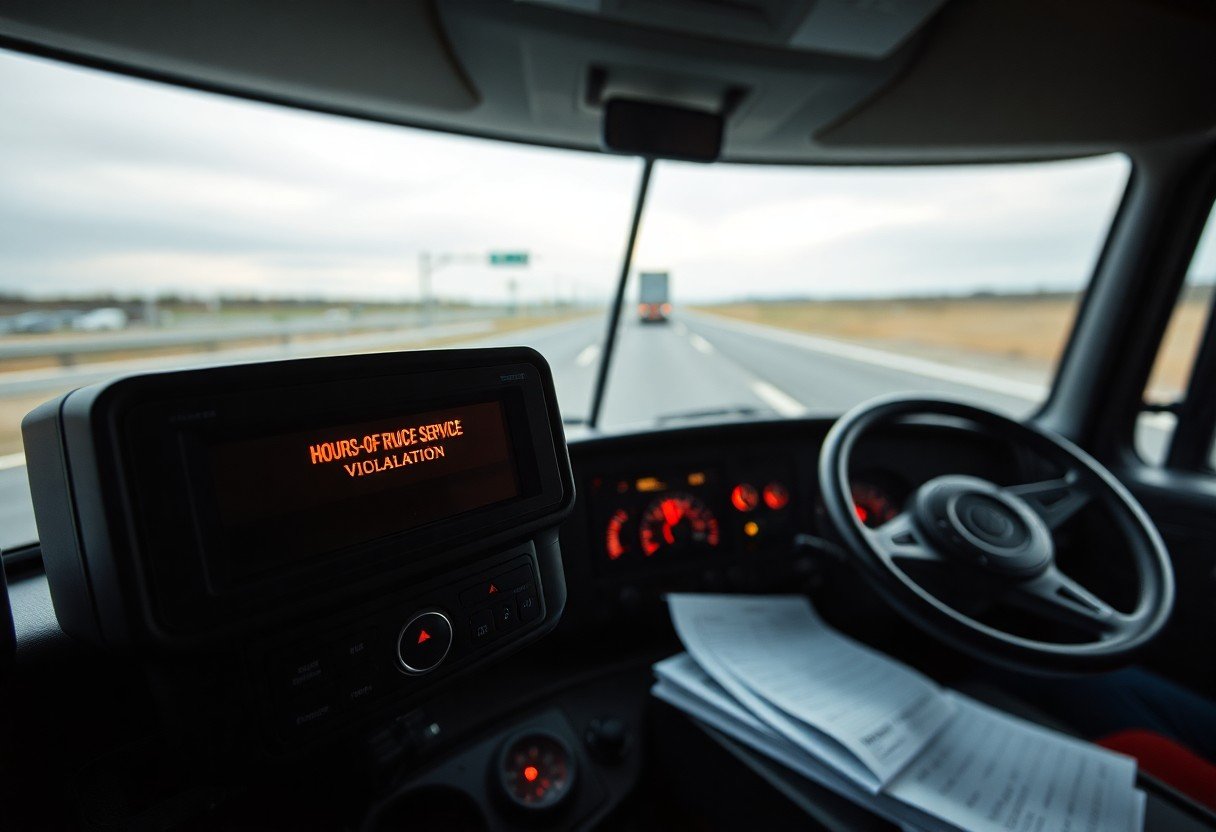
When you exceed these limits your ELD will flag violations that inspectors use during Level I and II roadside inspections; that can result in out‑of‑service orders, civil penalties, and higher insurance premiums, and it creates a clear record for crash investigators and plaintiff attorneys. Maintaining proper hours protects your driving privileges and your carrier’s safety rating.
For example, if you start duty at 6:00 AM your 14‑hour clock ends at 8:00 PM, so even with only 9 hours of driving you cannot resume driving past that clock; repeated overages raise your carrier’s BASIC scores and invite targeted audits or corrective action plans. You should audit ELD edits regularly, train drivers on rest scheduling, and use trip planning to avoid borderline HOS scenarios regulators scrutinize after crashes.
Common Hours-of-Service Violations
Types of Violations
You encounter specific violations frequently: exceeding the 11‑hour driving limit, working past the 14‑hour on‑duty window, skipping the required 30‑minute break, misusing the 34‑hour reset, and falsifying logs or tampering with ELDs; examples include driving 12 hours in a shift or recording on‑duty not driving to mask hours. Below are typical breach types and examples.
- Exceeding 11‑hour driving limit – e.g., 12 hours of driving logged after duty start.
- Breaching the 14‑hour duty window – staying on duty beyond the allowable period.
- Missing the 30‑minute break – no qualifying off‑duty or sleeper berth break within the shift.
- Improper 34‑hour reset use – reset taken incorrectly to extend weekly hours.
- Thou risk fines, out‑of‑service orders, and company investigations when these are uncovered.
| Exceeded 11‑hour driving limit | Driver logged 12 hours of driving in one duty period; citation likely |
| 14‑hour duty window breach | On duty beyond 14 hours after duty start; violation flagged in audit |
| Missed 30‑minute break | No qualifying break during shift; increases fatigue exposure |
| 34‑hour reset misuse | Reset taken inappropriately to reset weekly hours; compliance issue |
| Log falsification / ELD tampering | Altered records or disconnected ELD; leads to heavy fines and enforcement |
Impact on Safety
You face measurable safety degradation from hours violations: research equates about 18 hours awake to a ~0.05 BAC effect and 24 hours to ~0.10, which slows reaction time and decision making; microsleeps lasting 2-4 seconds at highway speeds can cover roughly 190-380 feet, turning routine stops into collisions and elevating crash risk for you and others on the road.
You should note how that impairment shows up: lane drift, delayed braking, diminished hazard detection, and increased near‑miss events captured by fleet telematics. For instance, a 3‑second microsleep at 65 mph carries you around 285 feet unsecured; post‑crash investigations often find hours‑of‑service violations alongside fatigued driving, which amplifies legal and financial consequences for you and your carrier.
Monitoring Driver Fatigue
You should tie electronic logs, telematics and in-cab sensors to observable signs-yawning, lane drift, microsleeps-and HOS data to get a complete picture. Federal limits (11-hour driving, 14-hour duty window, 30‑minute break after 8 driving hours, 60/70-hour weekly caps, 34-hour restart) give objective thresholds; correlating those with sleep history, shift rotations and roadside events lets you spot patterns before violations become incidents.
Technology and Tools
Use ELDs for immutable HOS records and integrate driver-facing cameras, steering sensors and wearables that track PERCLOS or heart‑rate variability to detect drowsiness. Machine learning models can flag risk based on prior sleep, route duration and time-of-day; some fleets report up to 40% fewer unsafe events after adding video coaching. Expect wearable unit costs around $100-$300 and camera/analytics subscriptions per vehicle.
Best Practices for Fleets
Adopt a fatigue risk management system (FRMS) that combines policy, data review and training: enforce the 10‑hour off-duty rule, design rosters to avoid chronic night shifts, require pre-trip fatigue checks, and run weekly HOS audits to catch trends. You should set automated alerts for near-limit driving, mandate immediate stop and report when drivers show two or more fatigue indicators, and document interventions for compliance evidence.
For example, a regional carrier that paired predictive scheduling with mandatory pre‑trip checklists, monthly driver coaching and automatic ELD alerts cut HOS violations by roughly 45% and reduced fatigue-related incidents by about 20% within a year. Implement clear escalation-two flagged events triggers retraining, three triggers medical evaluation-and track metrics (violations per 100,000 miles, median sleep hours) to measure program effectiveness.
Consequences of Violating HOS Regulations
Violations trigger immediate and long-term fallout: drivers can be placed out of service, carriers face audits, and your logbooks become evidence in lawsuits. Administrative fines often reach into the thousands, while severe or repeated breaches can lead to license suspension and criminal exposure. For case-specific guidance on how violations affect liability and settlements, see Truck Driver Hours of Service Violations & Case Impact.
Legal Repercussions
You can be cited for violating the 11-hour driving/14-hour duty rules or the 30-minute break and 34-hour restart provisions; those violations justify 10-hour out-of-service orders and CSA record hits. In crash cases, prosecutors may pursue misdemeanor or felony charges if fatigue is shown to cause death or serious injury. Civil plaintiffs routinely use inaccurate or falsified logs to prove negligence, increasing your exposure to jury awards and higher legal fees.
Financial Impacts
Your immediate costs include fines, towing or inspection fees, and lost revenue during out-of-service periods; fines commonly total from hundreds to several thousand dollars per violation. Longer term, insurers may raise premiums 20-50%, brokers may drop you, and settlements in fatigue-related crashes frequently reach six figures, directly hitting your bottom line and credit with shippers.
Beyond fines, an out-of-service order can cost you thousands per day in lost revenue and detention; for example, if a truck averages $1,200-$2,000 in daily gross, a 2-3 day shutdown wipes out $2,400-$6,000 before legal or repair bills. Additionally, elevated CSA scores reduce bid opportunities and can trigger corrective action plans that increase operational costs and contractual penalties.
Strategies for Prevention
Use layered controls: enforce FMCSA HOS limits (11-hour driving, 14-hour duty window, 10-hour off-duty and a 30-minute break after 8 hours driving), deploy ELD alerts and in-cab fatigue detection, and apply predictive scheduling to avoid quick returns. You should pair policy with tech – telematics that flag impending HOS breaches and biometric monitors reduce risk by signaling early fatigue. Companies that combine scheduling rules with real-time alerts see far fewer violations and better compliance metrics.
Effective Scheduling
You should design schedules that protect circadian sleep: avoid runs with under 10 consecutive hours off, limit more than 2-3 consecutive night shifts, and stagger start times to reduce early-morning peaks. Apply predictive algorithms to balance loads so drivers average predictable on/off patterns, and use split-sleeper options per HOS rules to allow restorative sleep without creating illegal duty windows.
Education and Training
You must train drivers on practical fatigue countermeasures: teach 15-30 minute strategic naps, safe caffeine timing (about 100-200 mg when needed), and signs of microsleeps. Deliver an annual 3-4 hour HOS and fatigue course plus quarterly 1-hour refreshers, and include hands-on ELD and fatigue-monitor tool sessions so your drivers can both comply and avoid impairment.
More training detail: you should include sleep hygiene (fixed sleep schedules, blackout curtains, avoiding heavy meals before rest), simulator scenarios of drowsy driving, and case-based reviews of past violations to analyze decision points. Also incorporate wearable sleep-tracker data review, structured debriefs after long hauls, and role-play for dispatch-driver negotiations so drivers learn when to assert rest without jeopardizing operations.
Conclusion
Drawing together, you can see how Hours-of-Service violations appear in log irregularities, telematics alerts, roadside inspection findings, and crash analysis; this evidence lets you quantify fatigue risk, guide enforcement, revise scheduling, and implement training so your operations reduce incidents and protect drivers.
FAQ
Q: What constitutes an hours-of-service (HOS) violation?
A: An HOS violation occurs when a driver or carrier breaks federal HOS rules in 49 CFR Part 395, such as exceeding the 11-hour driving limit within a work shift, driving beyond the 14-hour on-duty window, failing to take the required 30-minute off-duty break after 8 hours of driving, exceeding the 60/70-hour on-duty limits for the 7/8 consecutive day period, falsifying or altering logs, or failing to take an authorized 34-hour restart when applicable. Any failure to properly record status changes or to comply with short-haul or sleeper berth exceptions can also be cited as violations.
Q: How do electronic logging devices (ELDs) show HOS violations?
A: ELDs display violations on the record-of-duty-status (RODS) and the graph grid by flagging events that breach limits (over‑hours, missed breaks, unassigned driving). The device logs timestamps, engine-on/engine-off, vehicle movement, duty status changes, and annotations; it will mark specific events as violations and store diagnostic/malfunction codes. Inspectors and carriers can view or print the graph grid and detailed event list, which clearly show the period and type of violation and any driver annotations.
Q: How are HOS violations presented during roadside inspections?
A: During an inspection, officers review the ELD display or paper logs and record any violations on the inspection report with the applicable regulatory citation. The inspector will note the violation type, time periods involved, and whether the driver is placed out-of-service (OOS) until compliant. The printed graph grid or ELD data extract is typically attached to the inspection file and can be used as evidence in enforcement or adjudication.
Q: Where do recorded HOS violations appear in carrier and government systems?
A: Violations found during inspections are transmitted to FMCSA databases and appear on the carrier’s and driver’s inspection/violation history. Those records feed safety measurement and monitoring tools (e.g., SMS) and the driver’s pre-employment safety performance (PSP) history, which regulators and shippers use for safety evaluations. Repeated or severe violations can trigger interventions, fines, or increased enforcement attention.
Q: How can a driver or carrier correct or dispute an incorrect HOS violation?
A: Collect the ELD data export, supporting documents (dispatch records, bills of lading, fuel or toll receipts, repair orders), and any annotations or driver statements. Ask the carrier to review and, if appropriate, correct internal records. To dispute inspection or FMCSA-recorded violations, submit a DataQs request with supporting evidence or contest citations through the issuing agency’s citation process or the court. If the issue involves an ELD malfunction, document the malfunction, follow paper‑log procedures with annotations, and retain supporting proof when submitting corrections or disputes.