Most bicycle and car collisions raise complex liability issues that affect how you establish fault, document injuries, and pursue compensation; you need to understand traffic laws, evidence gathering, contributory negligence, insurance coverage, and possible defenses so you can protect your rights and make informed decisions about reporting, medical care, and legal options.
Key Takeaways:
- Traffic laws and right-of-way apply to both cyclists and drivers; violations like running lights, failing to yield, illegal passing, and dooring commonly establish liability.
- Liability is based on negligence-whether a party breached a duty of care (e.g., a driver’s obligation to avoid collisions) and that breach caused the injury.
- Comparative-fault rules often reduce recovery based on each party’s percentage of fault; some jurisdictions bar recovery if the cyclist is predominantly at fault.
- Timely evidence preservation matters: photos, video, witness statements, police reports, medical records, and the damaged bicycle help prove fault and damages.
- Handle insurance and legal timelines carefully: notify insurers promptly, avoid giving unguarded recorded statements or quick settlement acceptances, and watch statute-of-limitations deadlines.
Understanding Bicycle vs Car Collisions
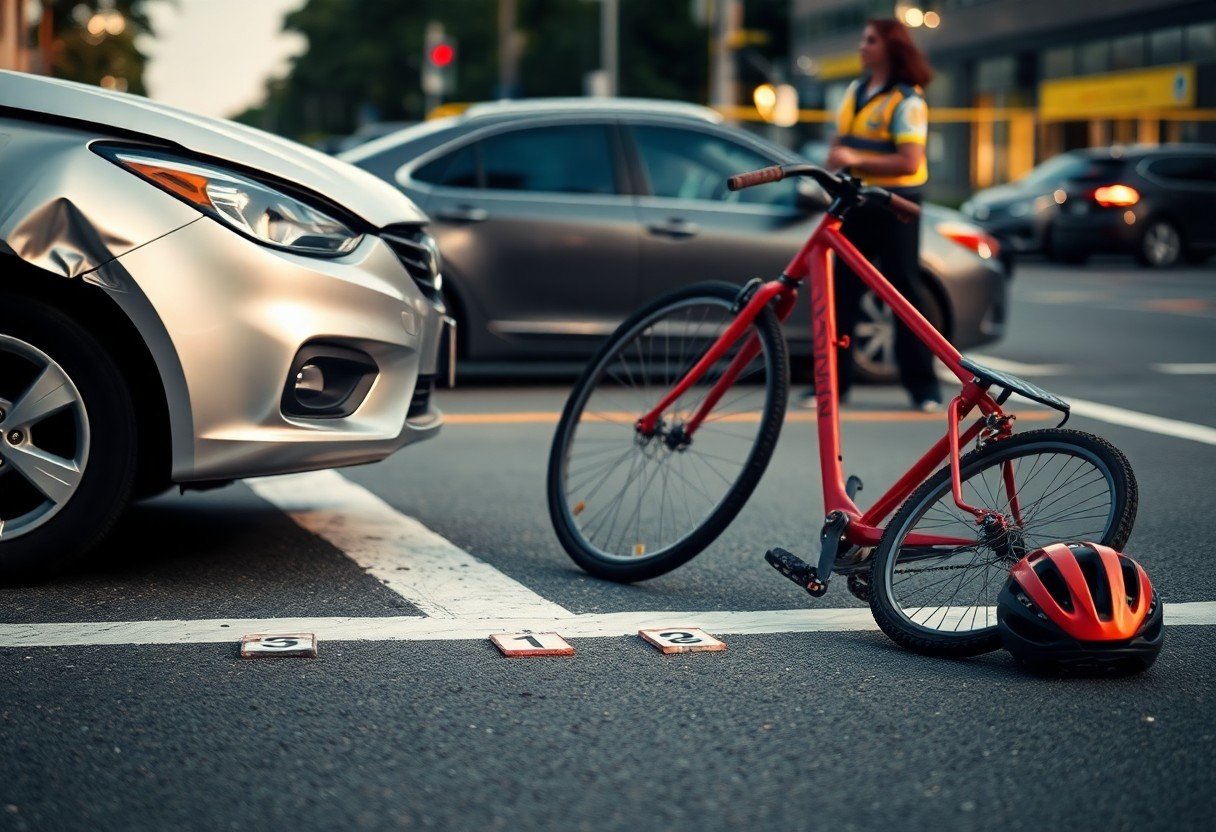
You should treat these incidents as high-impact liability events: speed differences often exceed 15-25 mph, intersections produce roughly 40% of reported crashes, and serious medical bills commonly surpass $50,000 per severe injury. Evidence such as skid marks, vehicle damage patterns, and helmet condition frequently determines causation, while insurer strategies hinge on whether driver negligence, roadway design, or bicycle positioning predominates.
Types of Collisions
You must distinguish angle, rear-end, left-hook, right-hook, and dooring crashes because each maps to different fault scenarios. After you align physical evidence and witness accounts with the collision type, causation and liability become clearer.
- Angle: vehicle turns across the cyclist’s path at intersections.
- Rear-end: vehicle strikes a cyclist from behind, common in low-light.
- Left-hook: vehicle turning left hits a cyclist going straight.
- Right-hook: vehicle turning right collides with a cyclist on the right.
- Dooring: parked driver opens a door into a cyclist’s path.
| Angle | Intersection conflicts when motorists fail to yield while turning across bike lanes. |
| Rear-end | Following too close or sudden stops, frequent at dawn/dusk or in congestion. |
| Left-hook | Driver misjudges cyclist speed or fails to see rider in adjacent lane. |
| Right-hook | Turning vehicle crosses a cyclist riding on the curb or in a bike lane. |
| Dooring | Parked car occupant opens door without checking, often on urban streets. |
Common Causes
You will most often encounter driver inattention, failure to yield, unsafe turning, dooring, and poor sight lines; distracted driving contributes to about 25% of urban bike crashes, while alcohol-related incidents increase injury severity. Road geometry-narrow shoulders and absent bike lanes-amplifies these risks, especially during peak commute hours.
In practice, you should collect precise timestamps, photos of vehicle damage and helmet condition, and any available CCTV or doorbell footage, because physical evidence pins down sequencing: for instance, scrapes on the rear wheel hub indicate a rear-impact; lateral intrusion and handlebar deformation point to a hook-type collision. Case law in many jurisdictions applies comparative negligence, so your ability to document bike positioning, lane markings, and driver signaling can shift fault percentages markedly-often moving a settlement from low five figures to substantially more when medical imaging and lost-wage documentation are added. Studies show protected bike lanes can reduce cyclist injury crashes by up to 50%, so demonstrating lack of infrastructure can strengthen claims tied to municipal design responsibility.
Legal Liability in Bicycle Accidents
Liability often turns on who violated traffic laws, roadway design, and available evidence such as video, police reports, and witness statements. When you can show the driver ran a stop sign or encroached on a marked bike lane, courts or insurers commonly assign primary fault to the motorist; conversely, if you were riding against traffic or failed to signal, comparative negligence may reduce your recovery proportionally-for example, being 20% at fault cuts damages by 20%.
Determining Fault
Investigators analyze skid marks, vehicle “black box” data, traffic-camera footage, and your phone or GPS records to reconstruct collisions. If you were in a marked bike lane and the driver lacked a turn signal, that evidence strongly supports your claim; alternatively, a citation for running a red light or riding on the wrong side can shift fault. In many states, traffic citations are powerful evidence that an insurer uses to assign liability.
Insurance Coverage Issues
Your recovery often depends on the driver’s liability limits, uninsured/underinsured motorist (UM/UIM) coverage, and any medical-payments (MedPay) benefits. Typical auto limits run from $25,000/$50,000 to $100,000/$300,000; if the at-fault driver lacks coverage, your UM policy or MedPay may cover immediate expenses. Bicycle-specific coverage sometimes appears in homeowner or renter policies for theft or damage but rarely for bodily injury-so you should check policy language promptly.
Start claims by notifying both the driver’s insurer and your own carrier within policy deadlines-often 30 days for initial notice. Expect insurers to request a recorded statement and to use settlement offers tied to policy limits; for example, carriers commonly offer full policy limits if liability is clear and injuries exceed $50,000. If the driver is uninsured and you lack UM/UIM, pursue a civil suit, but be aware collections depend on the driver’s assets and may not cover full losses.
Rights of Cyclists in Collision Cases
You have the right to seek compensation for medical bills, lost wages, property damage, and pain and suffering after a bicycle-car collision. Preserve evidence-photos, helmet, bike damage, and witness contact information-as insurers often decide claims in the first 30-90 days. File a police report and consult an attorney before giving recorded statements. For answers on liability timelines and common procedural issues see Common Legal Questions for a Portland Bicycle Accident …
Legal Protections
You are afforded the same rights and duties as motorists under state law, so you can claim negligence if a driver failed to yield, passed too closely, or ran a light. You also have the right to seek medical care, request a copy of the crash report, and demand full insurer disclosures. In practice, retaining counsel within weeks increases your chance of recovering full economic and non-economic damages.
Statutes and Regulations
State statutes set rules that directly affect liability: the 3-foot minimum passing law for motorists, traffic-signal and stop-sign violations, and a typical two-year statute of limitations for personal injury claims. Violations of these statutes provide strong evidence of negligence, while local ordinances can add protections in marked bike lanes.
Courts often treat a driver’s breach of ORS traffic provisions-failure to yield or unsafe lane changes-as prima facie negligence, shifting burdens in discovery and settlement talks. You should document citation numbers, timestamps, and medical records because insurers use them to calculate comparative fault; clear proof of a 3-foot pass or red-light violation can increase settlement offers substantially in serious injury cases.
Responsibilities of Drivers in Bicycle Accidents
You are expected to exercise heightened care around cyclists: maintain legal following and passing distances (many states require at least a 3-foot buffer), obey bike lane rights, and stop to exchange information after any collision. Failure to yield, speeding, or inattentive maneuvers often shifts liability to the driver. Police reports and vehicle data – speed, dashcam footage, witness statements – commonly determine fault, so securing photos and timely insurance notice protects your position.
Duty of Care
The duty requires you to operate with reasonable care, anticipating cyclist vulnerabilities when turning, merging, or opening doors. Violating traffic laws – running red lights, illegal turns, or failing to yield – can be treated as negligence per se; for example, left-hook collisions where you turn across a cyclist riding straight frequently result in driver fault. Adapting speed to conditions and scanning intersections reduces your legal exposure.
Avoiding Collisions
Before passing, confirm at least a 3-foot gap and scan for oncoming cyclists; signal turns at least 100 feet in urban settings and check blind spots twice. Sudden lane changes at 30 mph can leave a cyclist with under one second to react – slow down, move over, and complete your maneuver only when the lane is clear. Use mirrors and a shoulder check whenever merging or opening doors to prevent common right-hook and dooring crashes.
Anticipate common crash patterns: left-hooks occur when you misjudge a cyclist’s speed, and dooring happens within seconds after parking – the door zone stretches roughly 3 feet from parked cars, so check the bike lane before opening. When overtaking, reduce speed by 5-10 mph and wait for a clear 3-foot margin; these small adjustments increase your stopping window and help avoid disputes that often hinge on video or witness accounts.
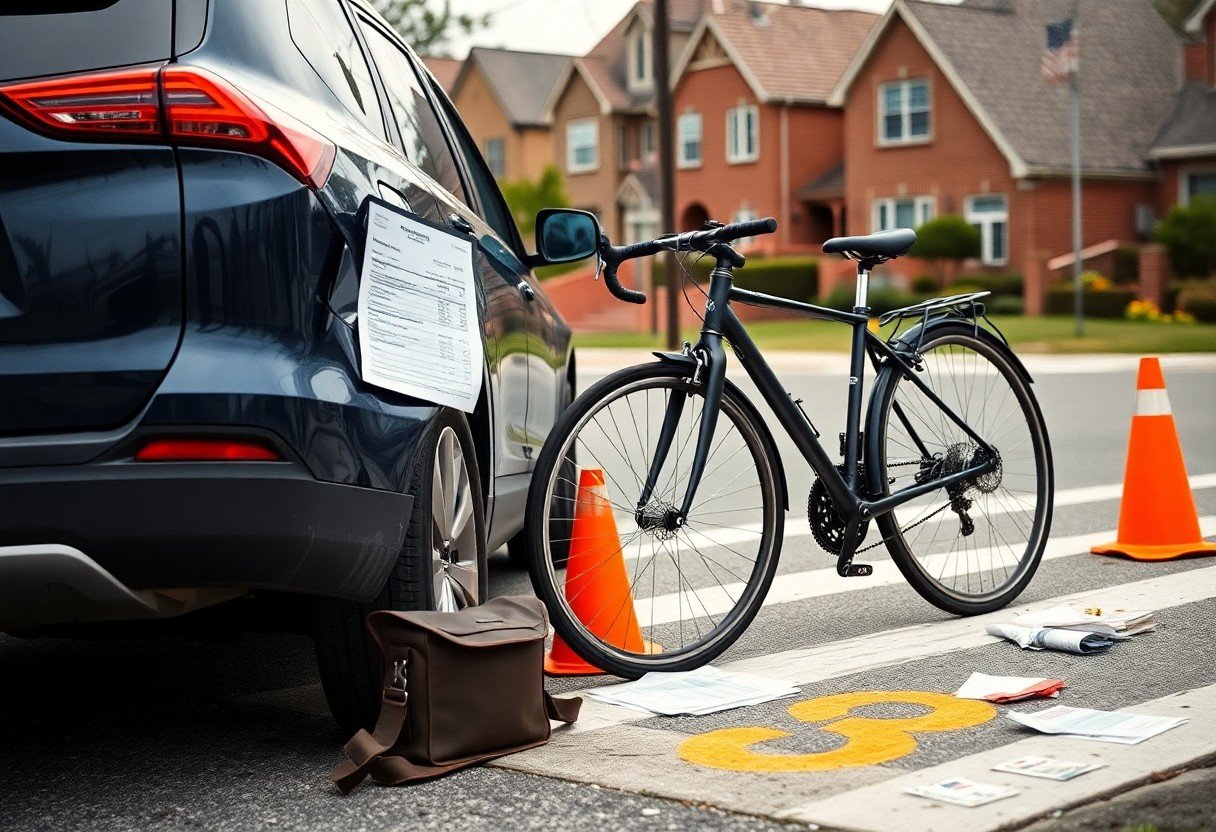
Injury Claims and Compensation
Types of Damages
You’ll pursue economic damages (medical bills, rehabilitation, future care estimates), non-economic damages (pain and suffering, loss of enjoyment), and occasionally punitive awards; courts and adjusters often use multipliers (commonly 1.5-4x economic damages) or per-diem formulas to value non-economic harm, and life‑care plans or vocational reports quantify long‑term needs so your claim reflects both current and projected costs.
- Economic: hospital bills, therapy, future medical projections.
- Lost wages: pay stubs, employer statements, vocational assessments.
- Non‑economic: pain, emotional distress, loss of consortium.
- Property: bike repair/replacement, helmet, accessories with receipts.
- Thou should note punitive damages require egregious conduct and are awarded infrequently.
| Economic damages | Medical bills, rehab, lifetime care estimates (often documented by life‑care plans) |
| Non‑economic damages | Pain & suffering; insurers may apply 1.5-4x economic totals or per‑diem methods |
| Lost income | Past wages + future earning capacity; payroll records and vocational experts support claims |
| Property loss | Bike repair/replacement costs; receipts and repair estimates establish value |
| Punitive awards | Rare, require reckless or malicious conduct; jury discretion varies by jurisdiction |
Settlement Process
In negotiations you typically start with a demand letter that itemizes bills, diagnostic imaging, lost wages, and a settlement figure; insurers often respond within 30-90 days, and mediation is common if talks stall-minor claims can settle in weeks, while cases needing expert reports often take 3-12 months, so you should keep treatment records and wage documentation current.
When preparing your demand package include itemized medical bills, physician narratives, imaging, and wage statements; expert input (life‑care planners, vocational economists, medical specialists) strengthens valuation, and a well‑documented demand often moves insurers from low initial offers to reasonable settlements without filing suit, whereas litigation raises costs and can extend resolution by a year or more.
Preventative Measures for Cyclists and Drivers
Safety Tips
Use a helmet certified to CPSC or EN standards and fit it snugly; studies show helmets cut head‑injury risk roughly 50-60%. You should ride predictable lines, signal 3-4 seconds before turns, and keep at least 3 feet (1 m) when passing. Drivers must check mirrors and blind spots, open doors with their far hand to prevent “dooring,” and slow to 20-25 mph in mixed traffic zones. Assume that consistent practice saves lives.
- Helmet: CPSC/EN certified; replace after any crash.
- Lights: white front and red rear visible from 500 ft for night riding.
- Position: ride 1-2 ft from parked cars or take the lane on narrow streets.
- Driver rule: give 3+ feet when passing and perform shoulder checks before turning.
Education and Awareness
You should enroll in a 3-6 hour on‑bike skills course (League of American Bicyclists, community programs) to master intersections, evasive braking, and lane control; studies link training to safer behavior. You should also join local driver safety sessions on sharing the road; some police departments offer free 1-2 hour briefings. Municipal Vision Zero campaigns in many cities have reduced cyclist injuries by as much as 20% over several years, showing policy plus education matters.
You should focus training on concrete skills: intersection right‑of‑way scenarios, 3-4 second signaling, mirror and shoulder checks every 5-8 seconds, and defensive braking drills at 10-15 mph. For drivers, practice the “Dutch Reach” to prevent dooring; for cyclists, rehearse emergency stops within 3 meters at about 9-10 mph. Employers can pair on‑bike modules with dashcam reviews to analyze near misses and improve protocols.
Final Words
On the whole you should assess fault by comparing actions, traffic laws, and evidence like eyewitness accounts, photographs, and vehicle data; insurance procedures, potential shared liability, and prompt legal consultation protect your rights and help secure fair compensation when bicycle vs car collisions raise complex liability questions.
FAQ
Q: Who is typically held liable in bicycle vs car collisions?
A: Liability depends on negligence rather than vehicle type. Courts and insurers examine whether the driver or cyclist breached a duty of care – for drivers this includes scanning for vulnerable road users, yielding when required, obeying signals, and maintaining control; for cyclists it includes following traffic laws, using lights at night, and signaling turns. Evidence of speeding, distracted driving, failure to yield, illegal turns, or riding against traffic often shifts primary fault to the motorist. Conversely, abrupt lane changes by a cyclist, running red lights, or riding on sidewalks where prohibited can reduce or negate motorist liability under comparative-fault rules.
Q: How do right-of-way rules apply at intersections, crosswalks, and bike lanes?
A: Right-of-way is context-specific: at intersections drivers must yield to pedestrians and to cyclists lawfully within crosswalks or lanes; turning motorists must yield to through traffic and to cyclists going straight. Protected bike lanes give cyclists priority over turning vehicles unless signage or signals indicate otherwise; unprotected lanes still require drivers to check blind spots before turning. Stop signs, red lights, and marked crosswalks confer clear duties; where markings are absent, investigators look at travel direction, signal phase, and who had a reasonable expectation of uninterrupted travel to assign fault.
Q: Does a cyclist’s helmet use affect liability or compensation for injuries?
A: Helmet use primarily affects injury severity evidence and may influence damage calculations in jurisdictions that consider comparative negligence or mitigation of damages. If a cyclist didn’t wear a helmet where law requires one, an insurer or court might reduce recoverable non-economic damages or argue partial fault for failing to mitigate injury. Conversely, helmets do not create liability for the motorist; failure to wear one rarely absolves a driver of negligence if the driver caused the collision. Medical records, helmet condition, and expert testimony are used to assess how helmet use impacted injury outcomes.
Q: What types of evidence best establish liability after a bicycle-car collision?
A: Photographs of vehicle and bicycle positions, skid marks, traffic signals, damage patterns, road conditions, and lighting are critical. Video (traffic cameras, dashcams, surveillance), eyewitness statements, the police accident report, and EMS/medical records strengthen causation and injury claims. Data from vehicle event recorders or smartphone GPS can show speed and trajectory. Preserving the bicycle and helmet, obtaining repair estimates, and documenting clothing or personal effects can corroborate contact points and impact dynamics. Timely statements to insurers and witness contact information preserve credibility.
Q: How do insurance claims, comparative fault, and defenses typically affect recovery?
A: Most claims begin with the motorist’s liability insurer; uninsured/underinsured motorist coverage on the cyclist’s policy can apply in hit-and-run or underinsured-driver cases. Recovery is governed by fault allocation-pure comparative, modified comparative, or contributory negligence rules vary by jurisdiction and influence whether and how much a plaintiff may recover. Common defenses include asserting the cyclist’s sudden maneuver, inadequate visibility, or municipal responsibility for road defects. Documentation of medical treatment, lost earnings, and repair bills is required to quantify damages; delays in reporting or gaps in treatment can weaken a claim.