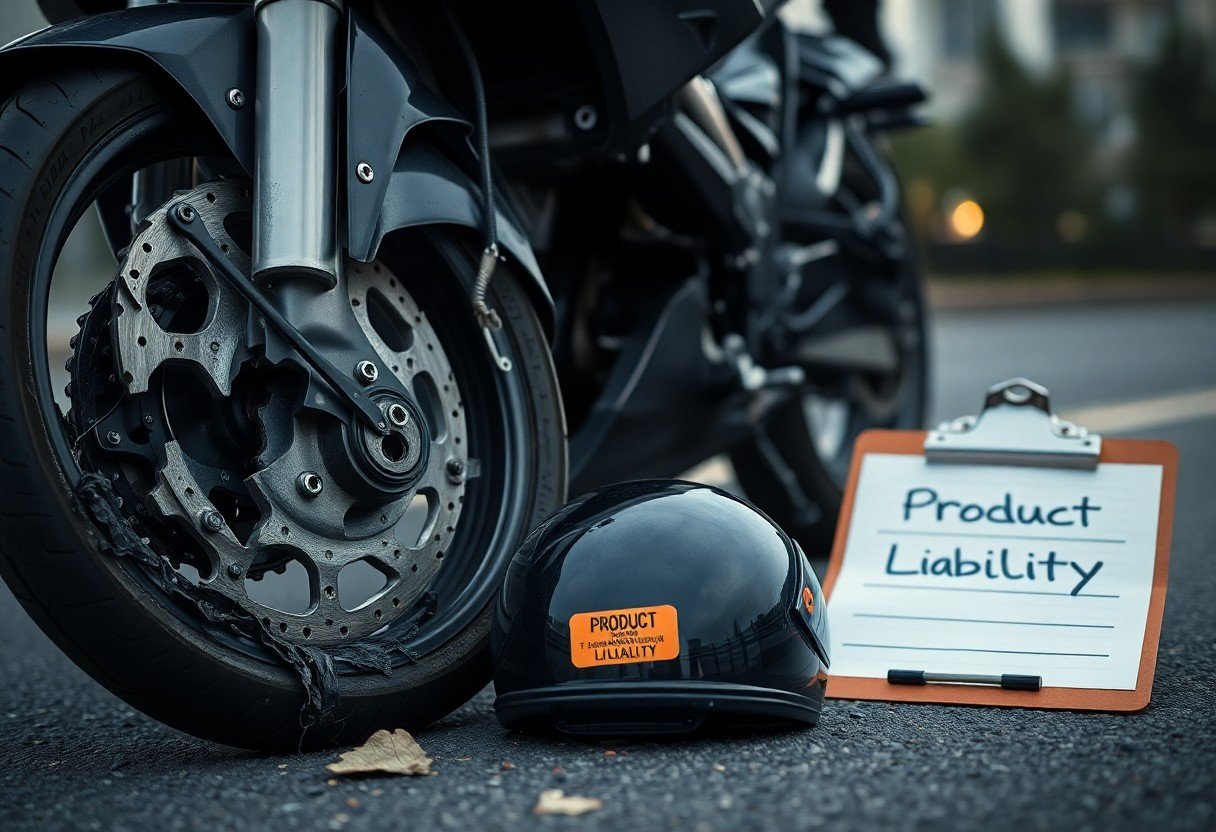
Liability for defective motorcycle parts determines who is responsible when a faulty component causes injury or loss, and you should know how product design defects, manufacturing errors, and inadequate warnings can establish manufacturer, distributor, or retailer responsibility. Knowing the role of evidence, expert testimony, and statutes of limitations helps you evaluate claims, preserve rights, and pursue compensation when a dangerous part harms you or your passenger.
Key Takeaways:
- Strict liability, negligence, and breach of warranty are common legal theories for defective motorcycle parts.
- Manufacturers, parts suppliers, distributors, and retailers can be held liable when a defect causes injury.
- Defects include design flaws, manufacturing errors, and inadequate warnings or instructions.
- Plaintiffs must prove defect, causation, injury, and damages; evidence includes the part, maintenance records, accident reports, and expert testimony.
- Defenses include misuse, modification, comparative fault, and statutes of limitation; preserve the part and documentation to strengthen a claim.
Understanding Product Liability
When a motorcycle part injures you or damages your property, product liability law decides who pays; it can hold designers, manufacturers, assemblers, distributors, and retailers accountable. Several jurisdictions apply strict liability, so you may not need to prove negligence-only that the part was defective and caused your loss. Statutes of limitations and repose vary by state, and recall data often strengthens claims, so you should document damage and act promptly to protect your rights.
Definition of Product Liability
Manufacturers, distributors, and sellers can be legally responsible when a motorcycle part’s defect harms you or your bike. Product liability covers design flaws, manufacturing errors, and failures to warn, and claims proceed under negligence, strict liability, or warranty theories. Courts will examine foreseeability, causation, and whether a reasonable alternative design or adequate warning existed; your ability to show the defect caused the incident is the pivotal element.
Types of Defective Products
Defects fall into three main categories you’ll see in cases: design defects (unsafe by design, such as geometry that induces instability), manufacturing defects (production errors like improper welding that lead to fractures), and warning defects (absent or inadequate instructions or hazard labels, such as missing torque specs). Recalls frequently involve these failures and can affect thousands of units, which can amplify your leverage when pursuing compensation.
- Design defect – unsafe concept or blueprint (example: frame geometry that causes high-speed weave).
- Manufacturing defect – deviation during production (example: improper heat treatment causing fork cracks).
- Failure to warn – missing instructions or hazard notices (example: absent torque specs leading to axle loosening).
- Assembly/installation error – quality-control lapses at factory or dealer that create hazardous conditions.
- Thou must photograph the component, preserve the damaged part, and keep invoices and repair records for later analysis.
| Defect Type | Typical Failure / Example |
|---|---|
| Design Defect | Frame geometry causing instability at highway speeds |
| Manufacturing Defect | Improper weld or heat treatment leading to swingarm fracture |
| Failure to Warn | Absent torque specs resulting in wheel separation |
| Materials Defect | Substandard alloy fatigue causing catastrophic break |
Courts apply two principal tests: the consumer-expectation test (would an ordinary user expect safe performance?) and the risk-utility test (did a feasible, safer alternative exist that reasonably reduced risk?). You should know that a low-cost design change or added warning can determine liability; forensic testing, failure rates, and whether recalls affected large production runs often sway outcomes, so preserve evidence and document timelines carefully.
- Preserve the damaged component and take timestamped photos from multiple angles.
- Keep service records, purchase receipts, and any prior communications with the seller or manufacturer.
- Report the defect to the manufacturer and to regulators (for U.S. cases, filing a report with NHTSA creates an official record).
- Seek medical attention and document all injuries and treatment related to the incident.
- Thou should consult an experienced product liability attorney to assess applicable statutes, potential defendants, and evidence strategies.
| Action | Why it Matters |
|---|---|
| Preserve part | Allows forensic analysis to link defect to failure |
| Photographs & records | Supports timeline, damages, and condition of part |
| Report to regulator | Creates official record and can trigger investigations or recalls |
| Legal consult | Identifies claims, deadlines, and potential defendants |
Common Types of Defective Motorcycle Parts
| Brakes | Caliper seizure, pad delamination, hose rupture causing sudden loss of stopping power at speed. |
| Tires & Wheels | Tread separation, bead failure, rim cracks – failures can occur suddenly on highways and during cornering. |
| Fuel System | Leaking tanks, defective pumps, or faulty valves that produce stalls or fire hazards in affected production runs. |
| Electrical / ECU | Shorts, poor solder joints, connector corrosion or software bugs that cause unexpected cut-outs or throttle issues. |
| Suspension & Steering | Fork seal failure, bearing defects, or tolerance errors producing wobble, reduced control, or component fracture. |
- You should monitor recall databases and VIN lookup tools for your model and year.
- Inspect for leaks, unusual noises, tire bulges, steering play, or inconsistent braking feel before rides.
- Document defects with photos, dates, and mileage to support claims or warranty work.
- After any sudden performance change you must stop riding and have the part retained and professionally inspected.
Design Defects
You’ll encounter design defects when an inherently unsafe choice – like inadequate heat shielding, poor chassis geometry, or insufficient guard placement – makes many units dangerous; these flaws often affect entire production runs and can trigger recalls or class actions, for example when a folded fuel tank design increases post-crash fire risk across thousands of motorcycles.
Manufacturing Defects
You face manufacturing defects when parts depart from the intended design during production: improper heat treatment, casting porosity, misassembled fasteners, or contaminated hydraulic fluid can produce premature axle fractures or brake failures within months of use.
You should know manufacturing defects are usually batch-specific and discovered through failure analysis: labs measure material hardness, X-ray castings, trace serial numbers to supplier lots, and calculate failure rates; preserving the failed component and service records helps you link a defect to a manufacturer or supplier and establish liability.
The Legal Framework for Product Liability
Strict Liability
Under strict liability, you typically need only show the motorcycle part was defective, the defect existed when it left the defendant’s control, and the defect caused your injury. Courts following Greenman v. Yuba Power Products (1963) and the Restatement (Second) of Torts §402A impose liability without proving negligence. For example, a brake caliper that shears under normal braking can trigger strict liability even if the manufacturer exercised care.
Negligence and Breach of Warranty
Negligence claims force you to prove duty, breach, causation, and damages; you must show the manufacturer failed to exercise reasonable care in design, manufacture, or warnings-for instance, improper heat treatment of a sprocket that leads to fracture. Breach of warranty, whether express or implied under UCC §2-314/§2-315, targets whether the part met marketed promises or ordinary merchantable standards, so an advertised “high-speed rated” tire that disintegrates supports a warranty claim.
Practically, you will often pursue both theories: negligence to prove the maker’s misconduct and warranty to establish product failure. Expert evidence-metallurgical testing, fatigue analysis, or service-history logs-commonly decides liability in fork or frame-failure cases. Statutes of limitations vary by state, typically two to four years, and comparative-fault rules can reduce recovery if your maintenance or modification contributed to the loss.
Proving a Defective Product Case
You must establish a defect, show that defect caused your injury, and prove damages; design, manufacturing, or warning failures require different proof strategies. You should preserve evidence, gather witness statements and maintenance records, and consult experts early. For patterns and recall context see How Motorcycle Defects Can Lead to a Personal Injury Case.
Burden of Proof
In civil product cases you prove the case by a preponderance of the evidence-more likely than not. Many jurisdictions apply strict liability so you don’t always need to show manufacturer negligence, yet internal documents, testing results, or prior recalls often shift outcomes. You must also account for comparative fault and statutes of limitations, which commonly run 2-3 years after the crash.
Gathering Evidence
You should preserve the motorcycle and avoid repairs so parts remain intact; photograph damage from multiple angles, record the VIN, save service and purchase records, collect witness contacts and the police report, and note road and weather conditions. Check NHTSA recall history and secure any onboard data before it’s overwritten.
Beyond initial preservation, arrange a forensic teardown by an engineer to document failure modes and request preservation letters to prevent spoliation. Establish a chain-of-custody for parts and fluids, and obtain expert reports-reconstructionists, metallurgists, or brake specialists-to identify micro-fractures or assembly defects. Acting within days preserves ECU/data-logger readings and strengthens depositions and settlement leverage.
Potential Defendants in Motorcycle Product Liability Cases
Manufacturers
OEMs and tier‑one suppliers are often your first targets in a claim, since they design and build systems like brakes, fuel delivery, and steering. Manufacturers issued hundreds of motorcycle recalls over the past decade for brake failures, faulty throttles, and defective suspension parts, and courts commonly apply strict liability for design and manufacturing defects. If a component’s specifications or quality control failed, you can name the designer, assembler, and any subcontracted parts maker.
Distributors and Retailers
Distributors, dealers, and online retailers can be liable if they introduce a defective part into the stream of commerce or improperly modify it. You should consider wholesalers, importers, and service shops as potential defendants when a replacement part was installed or altered-liability often attaches when a seller knowingly distributes recalled items, fails to provide warnings, or alters safety labels.
When you buy parts through third‑party marketplaces or independent shops, multiple entities might share responsibility: the importer who labels the part, the distributor who warehoused it, and the retailer who sold or installed it. Jury verdicts and settlements in catastrophic cases frequently reach five‑ to seven‑figure ranges, so preserve invoices, installation records, and communications to link each actor to your injury.
Seeking Compensation for Injuries
Types of Damages Available
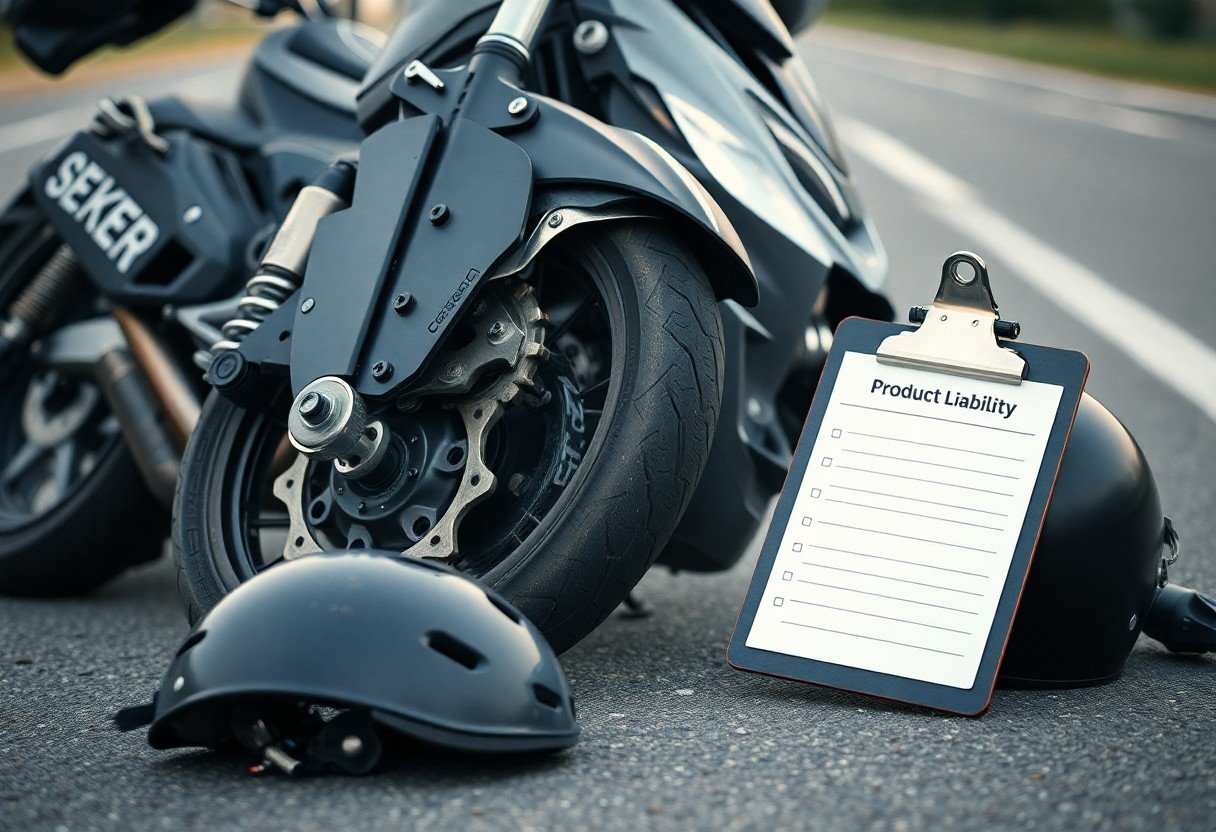
You can pursue economic, non-economic, and sometimes punitive damages after a defective motorcycle part causes injury; economic damages reimburse quantifiable losses like medical bills and lost wages, while non-economic damages cover pain and suffering and loss of enjoyment of life, with punitive awards reserved for particularly reckless conduct.
- Economic damages: past medical bills, ongoing care, and lost earnings-often supported by billing records and payroll statements.
- Non-economic damages: pain, disfigurement, and emotional distress-commonly quantified by multipliers or per diem methods.
- Loss of consortium and diminished quality of life claims: spouse or family members may recover in severe cases.
- Punitive damages: awarded less frequently but can exceed compensatory awards when misconduct is willful.
- Any claim for future medical care requires life-care plans, expert testimony, and detailed cost projections to prove need and amount.
| Economic Damages | Medical bills, rehab, lost wages; serious crashes often exceed $50,000 in initial costs |
| Non‑Economic Damages | Pain & suffering, emotional distress; commonly estimated using multipliers (1.5-5× economic loss) |
| Punitive Damages | Rare; designed to punish gross negligence-can be multiple times compensatory awards |
| Future Care | Life‑care plans and discounted future cost estimates; spinal cord or traumatic brain injuries may require seven‑figure forecasts |
| Property Damage | Repair/replace your motorcycle and gear; typical claims range from a few hundred to tens of thousands of dollars |
Navigating Insurance Claims
You should report the crash promptly, preserve evidence (photos, repair estimates, medical records), and submit a well‑documented claim package; insurers often acknowledge claims within 30 days, but early settlement offers can be low-get written demand letters with itemized bills and wage loss documentation to push for fair value.
When value is disputed, you can request policy limits, demand full medical records, and use expert reports (orthopedists, life‑care planners, vocational specialists) to justify future costs; consider uninsured/underinsured motorist coverage and note that statutes of limitations commonly run 2-3 years in many jurisdictions, so consult counsel if insurer delays.
Final Words
Taking this into account, if you encounter defective motorcycle parts you should document the defect, preserve evidence, and consult a qualified attorney to assess manufacturer, designer, or seller liability; understanding filing deadlines and obtaining expert testimony will strengthen your claim and help you pursue fair compensation for injuries and losses while holding responsible parties accountable.
FAQ
Q: What does “product liability” mean for defective motorcycle parts?
A: Product liability holds manufacturers, suppliers, or sellers legally responsible when a defective motorcycle part causes injury or property damage. Claims typically proceed under three theories: strict liability (the product was defective and unreasonably dangerous), negligence (failure to exercise reasonable care in design, manufacture, or warnings), and breach of warranty (express or implied promises about fitness or safety). To prevail a plaintiff must show a defect, causation linking the defect to the injury, and actual damages.
Q: What are the common types of defects in motorcycle parts?
A: Defects usually fall into three categories: design defects (an inherently unsafe design affecting an entire product line, e.g., brake system geometry that fails under normal use), manufacturing defects (errors during production that make a specific unit unsafe, e.g., improperly heat-treated axles or contaminated brake fluid), and marketing defects/failure to warn (inadequate instructions or warnings about risks, e.g., missing torque specs or improper tire-pressure warnings). Each type changes proof and potential remedies in a claim.
Q: Who can be held liable after an accident caused by a defective motorcycle part?
A: Potentially liable parties include the original equipment manufacturer (OEM) of the bike, component manufacturers (brakes, tires, electronic modules), aftermarket part makers, assemblers, distributors, and retailers. Liability can extend to companies that altered, repaired, or remanufactured parts if their actions introduced defects. Contractual relationships and the role each actor played in the supply chain determine which legal theories and remedies apply.
Q: What evidence should I preserve after a crash involving suspected defective parts?
A: Preserve the defective part(s) intact and avoid repairs or disposal. Photograph the part, the vehicle, skid marks, and the accident scene. Keep maintenance records, purchase receipts, any warnings or manuals, and protective gear. Obtain witness statements, medical records, and police reports. Secure the vehicle in a way that prevents tampering and obtain a professional inspection and written report from a qualified mechanic or reconstruction expert. Prompt preservation supports inspection by experts and strengthens a claim.
Q: What deadlines and remedies apply in product liability cases for motorcycle parts?
A: Statutes of limitation and repose vary by jurisdiction; common deadlines range from one to six years after injury for filing, while repose periods may bar claims after a fixed period from sale regardless of discovery. Remedies include compensatory damages (medical expenses, lost income, property damage, pain and suffering) and, in some cases, punitive damages for reckless conduct. Practical steps: seek medical care, document injuries and expenses, check for recalls, preserve evidence, report the incident to insurers, and consult an attorney quickly to assess deadlines and viable claims.