Most slip, trip, and fall incidents arise from hazards a property owner knew or should have known about, and understanding premises liability helps you pursue an injury claim; you must show the owner owed a duty of care, breached it, and that breach caused your damages, collect evidence like photos and witness statements, and be aware of comparative fault and filing deadlines to protect your recovery.
Key Takeaways:
- Property owners owe a duty to keep premises reasonably safe for invited visitors; the level of duty depends on visitor status (invitee, licensee, trespasser).
- Liability requires proving the owner knew or should have known about the hazardous condition and failed to repair it or provide adequate warning (actual or constructive notice).
- Establish causation with contemporaneous evidence: photos of the hazard, incident reports, medical records, and witness statements.
- Comparative fault rules can reduce recovery if the injured party was partly negligent; strict statutes of limitations govern filing deadlines.
- Recoverable damages commonly include medical costs, lost wages, rehabilitation, and pain and suffering; prompt documentation and legal advice strengthen a claim.
Understanding Premises Liability
When assessing a slip, trip, or fall claim you should examine duty, breach, causation, and damages: who controlled the area, what inspections occurred, and whether the hazard was foreseeable. Courts often reference the Restatement (Second) of Torts and local statutes, while evidence like surveillance, maintenance logs, and witness statements can establish notice and link the owner’s conduct to your injuries.
Definition of Premises Liability
Premises liability governs when a property owner is legally responsible for injuries you sustain on their land, hinging on control of the premises, visitor classification (invitee, licensee, trespasser), and whether the danger was known or should have been discovered by reasonable care. The law focuses on whether the owner failed to correct or warn about a hazardous condition that caused your harm.
Legal Standards for Property Owners
Property owners generally owe the highest duty to invitees and lesser duties to licensees and trespassers, and liability typically requires proof of actual or constructive notice-shown by surveillance footage, maintenance records, or evidence the hazard existed long enough (often minutes to hours in retail) for discovery and remediation; open-and-obvious defenses and local comparative-fault rules can limit or bar recovery.
In practice, you can strengthen a claim by obtaining store inspection schedules (many retailers perform 15-30 minute aisle checks), employee shift logs, and video timestamps to show constructive notice. Courts scrutinize whether warnings were adequate-cones or signs may be insufficient if the danger was concealed-and will reduce awards if your own negligence contributed to the fall under comparative negligence doctrines.
Common Causes of Slip, Trip, and Fall Accidents
Slips, trips, and falls often stem from identifiable hazards on properties: wet floors, uneven flooring, poor lighting, cluttered walkways, torn carpeting, and unguarded edges. You should assess how long a hazard existed, whether staff followed inspection protocols, and whether warning measures were used; for example, a spill left unmarked for 10-15 minutes in a busy store is frequently dispositive in claims. Falls remain the leading cause of nonfatal emergency visits.
Wet or Slippery Floors
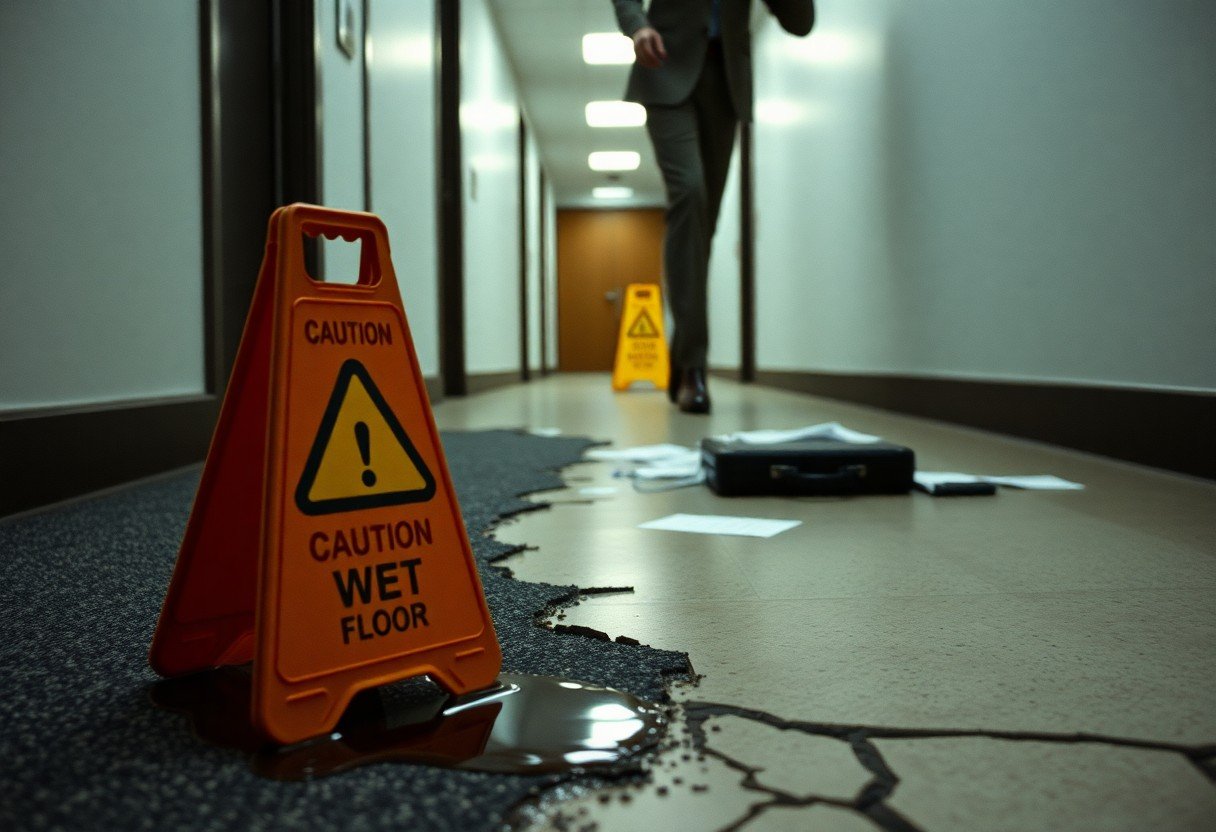
Spills, tracked-in rain, grease, and freshly mopped or waxed surfaces create immediate slip risks. You should check for missing mats, absent cones or signage, and gaps in cleaning logs; surveillance footage often shows response delays. In retail and food service, a documented response time under 5-10 minutes and consistent wet‑floor procedures can sharply reduce liability exposure, while lapses strengthen a plaintiff’s case.
Uneven Surfaces and Poor Maintenance
Cracked sidewalks, raised thresholds, potholes, curled carpet edges, and missing handrails are typical trip hazards. You should note vertical differentials-many local ordinances flag hazards over 1/2 inch-plus lighting deficiencies and deferred repairs. Repeated complaints or documented maintenance backlogs create a pattern that makes a property owner’s failure to remedy hazards more persuasive in court.
Proving liability for uneven surfaces usually depends on notice and repair timelines: you should collect maintenance logs, repair invoices, prior incident reports, and surveillance images showing how long the defect persisted. Expert measurements and clear photographs documenting a 1/2-1 inch height difference, combined with staff reports or tenant complaints days earlier, can establish constructive notice and turn neglect into a compensable breach.
Establishing Negligence in Injury Claims
To prove negligence you must link the property owner’s duty to an actionable breach that caused your injury and measurable damages. Use concrete evidence-surveillance video showing a 25-minute unattended spill, a maintenance log with 4-hour inspection intervals, and a witness statement-to show foreseeability and failure to act. Courts weigh whether the hazard was obvious, how long it existed, and whether the owner followed industry practices such as hourly checks in high-traffic areas.
Duty of Care
Property owners and occupiers owe duties that depend on your status: as an invitee (customer) they must inspect and remedy hazards, as a licensee they must warn of known dangers, and as a trespasser duties are limited. If you were shopping, for example, the store should have had documented aisle inspections-many chains require checks every 30-60 minutes-which you can compare against to show a duty was owed to keep you safe.
Breach of Duty
You show breach by proving the owner failed to meet the applicable standard: no warning signs, missed scheduled inspections, or ignored repair requests. For instance, if a company policy required 30-minute spill checks but CCTV shows a spill remained 20 minutes unaddressed before your fall, that gap supports breach. Code violations, absence of anti-slip mats, or poor lighting also illustrate departure from reasonable care.
Concrete proof of breach often comes from documents and time-stamped media: maintenance logs, employee duty rosters, incident reports, and surveillance footage. Prior complaints or similar incidents in the same location strengthen your case by showing notice. Expert testimony on industry standards (e.g., ANSI floor traction recommendations) and internal policies that weren’t followed creates a timeline linking the owner’s conduct to the hazardous condition.
Causation and Damages
Causation requires both factual (“but-for”) and legal (proximate) links between the breach and your injury: you must show the hazardous condition directly caused the fall and the harm was a foreseeable result. Medical records, emergency-room notes, and time-stamped photos from the scene tie the event to your injury, while employer records and paystubs document lost wages and help quantify economic loss.
To calculate damages, assemble objective proof: hospital bills, imaging (X-ray/MRI), physical-therapy invoices, and wage statements. Use physician projections and vocational experts to estimate future care and lost earning capacity; for example, surgery plus rehab for a displaced wrist fracture can total tens of thousands of dollars and months off work. Also assess non-economic losses-pain and reduced quality of life-and be aware some jurisdictions limit those awards.
Steps to Take After a Slip and Fall Incident
After a fall, prioritize medical attention and evidence preservation: seek emergency care for head, neck, or severe limb pain or call 911, otherwise see a physician within 48 hours to document injuries. Report the incident to on-site staff, note the exact location and time, and photograph the scene before cleanup; many states have a 2-3 year statute of limitations, so move quickly to protect your claim.
Reporting the Accident
Immediately notify the property manager or business and ask for a written incident report, obtaining the staff member’s name, title, and a copy or incident number. If police responded, record the officer’s name and report number. Also inform your insurer and request preservation of CCTV and other surveillance, since many systems overwrite footage within 7-30 days.
Documenting Evidence
Photograph the hazard, surrounding area, lighting, floor condition, your footwear, and visible injuries from multiple angles, using timestamped phone images when possible. Gather witness names and contact details, keep torn clothing or shoes, and save receipts for emergency care-these concrete items establish condition, causation, and damages.
Act fast to preserve perishable evidence: request written preservation of CCTV within 48-72 hours because many stores overwrite footage in 7-30 days. Obtain medical records, imaging, bills, and employer documentation of lost wages. Maintain a dated symptom log noting pain levels and activity limits, keep originals and duplicates of all documents, and avoid public social posts that could be used against your claim.
Legal Considerations and Limitations
When you pursue a slip-and-fall claim you must act within legal limits and understand distinctions between claim types-see Premises Liability Vs. Slip And Fall Claims: Key Differences Explained for contrasts that affect liability, notice requirements, and available damages; missing a deadline or misclassifying the claim can cost you compensation or shorten discovery deadlines in complex cases.
Statute of Limitations
You generally have a limited window to file: most states set personal-injury limits between 1 and 6 years, with many at 2-3 years (California 2 years, New York 3 years). If you wait beyond your state’s statute of limitations, courts usually dismiss the suit, so verify your deadline immediately and preserve evidence and medical records within weeks of the incident.
Statute of Limitations – Quick Facts
| Typical range | 1-6 years depending on state |
| Common examples | California 2 years; New York 3 years; some states shorter for government claims |
| Action you should take | File suit or tolling motion before deadline; document injury and notice to owner |
Comparative Negligence
You may still recover damages if you’re partly at fault, but recovery drops by your percentage of fault; if you’re 30% responsible for a fall and damages total $100,000, you would collect $70,000. States follow either pure comparative rules (recover regardless of fault share) or modified rules that bar recovery once your fault hits a 50% or 51% threshold.
In modified systems many states bar recovery when you’re 50% or more at fault (or 51% in others); courts allocate fault using evidence such as surveillance, incident reports, and expert testimony, so comparative percentages are often litigated vigorously-your ability to reduce an assigned fault percentage through witness statements or objective data can materially raise your net recovery.
Comparative Negligence – Summary
| Pure comparative | You recover reduced by your fault percentage (e.g., 80% recovery if 20% at fault) |
| Modified comparative | Recovery barred if your fault ≥50% (or ≥51% in some states); otherwise reduced |
| Practical tip | Document the scene and gather witness statements to contest fault allocation |
Potential Compensation and Damages
Damages in slip, trip, and fall claims typically include economic losses like past and future medical bills and lost earnings, plus non-economic harms such as pain, suffering, and loss of enjoyment. You should expect settlements to reflect documented costs and the severity of injuries; minor sprains often settle for a few thousand dollars, while complex fractures or spinal injuries can reach tens or hundreds of thousands.
Medical Expenses
You can recover all reasonable past and future treatment costs: ER visits, X-rays/MRIs, surgery, medications, rehab, and durable medical equipment. For example, an ER visit may cost $1,200-$2,500, an MRI $400-$3,000, physical therapy $50-$200 per session, and surgeries can range from $10,000 to over $50,000 depending on complexity.
Lost Wages and Pain and Suffering
You may claim lost wages for time off work and reduced earning capacity if injuries persist. If you miss eight weeks at $800/week, that’s $6,400 in lost earnings; a permanent impairment can justify future wage-loss estimates using vocational and economic experts. Pain and suffering covers physical and emotional distress beyond bills.
Courts and insurers calculate non-economic damages using methods like a multiplier of economic damages (commonly 1.5-5× for pain and suffering) or per diem rates tied to daily impact. You’ll need pay stubs, employer statements, medical records, and diaries documenting pain and limitations. For future loss, expert testimony on prognosis and earning capacity strengthens your claim and can shift settlements substantially upward.
Conclusion
Following this, you should document injuries, preserve evidence, and obtain prompt medical care to strengthen your premises liability claim; collect photos, witness contacts, incident reports, and any maintenance records, and consult an experienced attorney to evaluate duty, breach, causation, and damages, meet filing deadlines, and negotiate fair compensation for medical bills, lost wages, and pain and suffering so you protect your rights after a slip, trip, or fall.
FAQ
Q: What elements must I prove in a slip, trip, and fall premises liability claim?
A: You must typically prove four elements: (1) the property owner/operator owed you a duty of care (duty varies by visitor status-invitee, licensee, trespasser); (2) the owner breached that duty by creating or failing to address a hazardous condition; (3) the breach was the actual and proximate cause of your fall and injury; and (4) you suffered compensable damages (medical bills, lost wages, pain and suffering). Evidence often used includes photos, surveillance video, maintenance and inspection logs, incident reports, witness statements, and medical records linking the fall to your injuries.
Q: How is the property owner put on notice of a dangerous condition?
A: Notice can be actual (the owner knew about the hazard), constructive (the condition existed long enough that the owner should have discovered it through reasonable inspection), or created by the owner or their employees. Courts examine how long the hazard was present, the property’s inspection and maintenance practices, warning signs, and whether the owner had reason to anticipate the risk. Spoliation of evidence, such as destroying surveillance footage or discarding hazard evidence, can hurt the owner’s defense.
Q: How does comparative negligence affect my recovery in a fall case?
A: If the jurisdiction applies comparative negligence, your award is reduced by the percentage of fault attributed to you. Under pure comparative negligence you can recover even if you are mostly at fault; under modified comparative negligence you may be barred from recovery if your fault exceeds a threshold (commonly 50% or 51%). Fault may be assigned for factors like inattention, inappropriate footwear, or ignoring warnings. Establishing strong evidence of the defendant’s negligence limits your assigned percentage of fault and preserves recovery.
Q: What immediate steps should I take after a slip, trip, or fall to protect a claim?
A: Seek medical attention and follow all treatment. Take time-stamped photos of the hazard, surroundings, your clothing and footwear, and any injuries. Obtain contact information for witnesses and request a copy of any incident report from the property. Preserve physical evidence (shoes, clothing) and avoid posting details on social media. Request preservation of surveillance video in writing. Keep records of medical bills, pay stubs for lost wages, and all communications with the property owner or insurer.
Q: How long do I have to file a premises liability lawsuit and what damages can I recover?
A: Statutes of limitations vary by state but commonly range from one to three years from the date of injury; some shorter deadlines apply against governmental entities and require advance notice. Damages can include economic losses (medical expenses, past and future lost earnings, rehabilitation, future medical care), non-economic losses (pain and suffering, emotional distress, loss of enjoyment of life), and in rare cases punitive damages for egregious conduct. Consult an attorney promptly to preserve time-sensitive rights and to calculate full damages, including future needs.