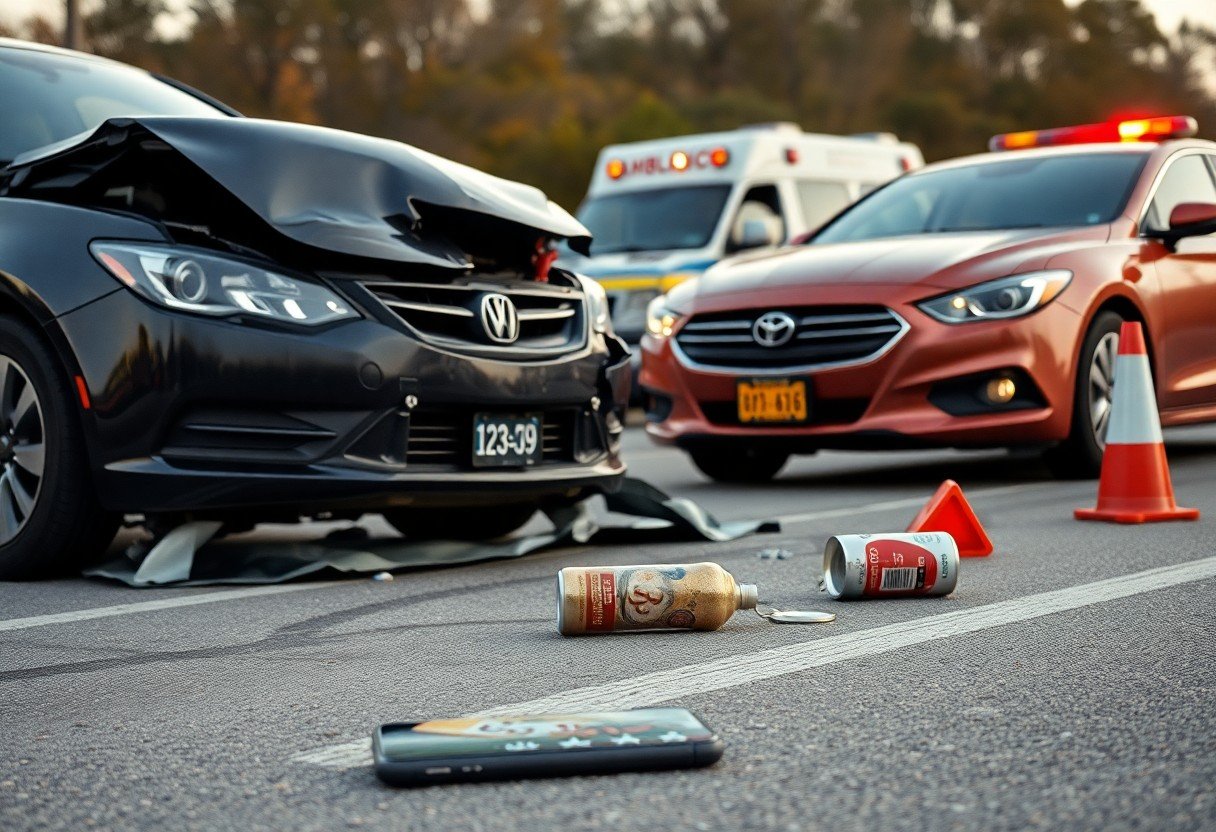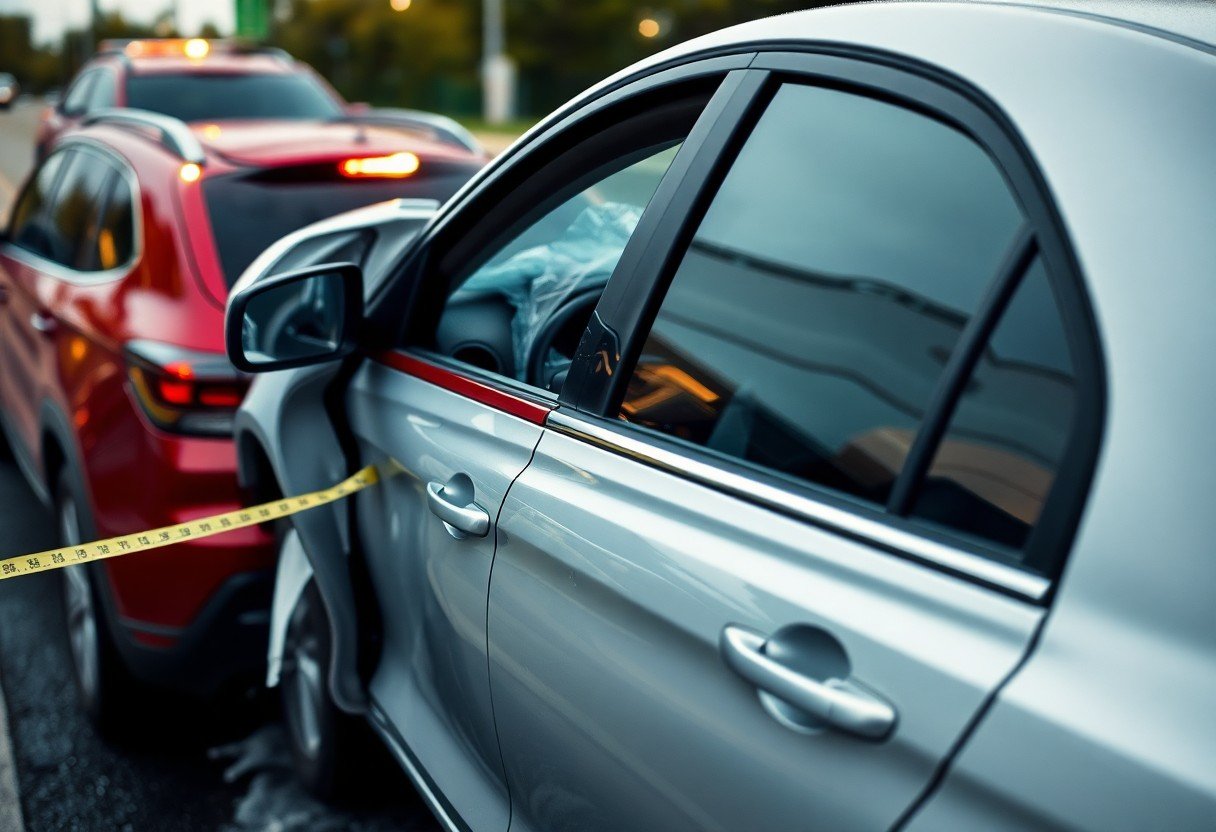
There’s a predictable pattern of trauma and documentary evidence you should watch for after your vehicle is struck in a T-bone (side-impact) collision: lateral rib and pelvic fractures, spinal compression, head and neck injuries from sudden lateral acceleration, and soft-tissue damage. You need prompt medical evaluation, thorough imaging, detailed vehicle damage photos, witness statements, scene measurements, and data from event recorders to link your injuries to the impact and establish liability.
Key Takeaways:
- Common injury patterns: lateral head and brain injuries, cervical spine lateral bending/rotation, rib and sternal fractures, pulmonary contusions, abdominal organ lacerations, pelvic and femur fractures from door intrusion.
- Mechanism of harm: limited crush space and direct lateral loading produce high lateral accelerations and concentrated focal forces from door or intruding structures, increasing risk of severe TBI, thoracic injury, and pelvic trauma.
- Physical crash proof: damage pattern and intrusion measurements, point-of-impact alignment with occupant position, skid marks, surveillance/witness accounts, and event data recorder (EDR) output support causation.
- Medical proof: emergency records, imaging (CT/MRI, X‑ray), documented contusions/fractures, neurologic assessments, and contemporaneous symptom progression link injuries to the collision.
- Expert analysis: crash reconstruction and biomechanical causation opinions map kinematics to injury patterns and distinguish crash-related trauma from preexisting conditions or unrelated events.
Overview of T-Bone Accidents
Definition and Mechanics
You experience a T‑bone when another vehicle strikes your side near a perpendicular angle, producing lateral delta‑v that door beams and B‑pillars must absorb. At urban speeds (25-35 mph) intrusion of 30-40 cm is common, displacing occupants laterally and causing rib fractures, pelvic breaks, and brain movement despite airbags. Crash tests show side structures offer less crush space than front ends, so your torso and head endure direct loads and rapid lateral acceleration, producing the characteristic rib, pelvic, and shoulder injuries seen in medical records.
Common Causes
Intersections are the primary scene: left turns that misjudge oncoming speed, red‑light running, and failure to yield produce many T‑bones. You also face elevated risk from impaired or distracted drivers, obstructed sightlines from parked vehicles or landscaping, and complex multi‑lane signals. Police crash narratives and traffic studies frequently list driver decision errors and signal violations as the proximate causes, especially during morning and evening peak hours when exposure and speed differentials are highest.
Left‑turn maneuvers are particularly hazardous because the turning vehicle crosses lanes into oncoming traffic, so a 30-40 mph impact transfers concentrated lateral energy. You can visualize why an SUV striking the side of a compact car causes greater intrusion into the passenger compartment, boosting pelvic and head injury rates. Case reviews also show that poor visibility, misjudged gaps, and mobile‑phone distraction often co‑occur, increasing intrusion depth and raising AIS injury scores in victims.
Injury Patterns in Side-Impact Collisions
Types of Injuries Sustained
You typically sustain concentrated lateral trauma: rib and pelvic fractures from direct compression, lung contusions and hemothorax from chest wall intrusion, liver or spleen lacerations from abdominal crush, and focal traumatic brain injury from rapid head rotation; studies show side airbags can reduce driver fatality risk in near‑side crashes by about 45%.
- Rib and sternal fractures with localized chest pain and impaired ventilation.
- Intrathoracic injuries (pulmonary contusion, hemothorax) causing hypoxia or delayed respiratory failure.
- Abdominal solid‑organ lacerations (spleen, liver) presenting with hypotension or dropping hemoglobin.
- Knowing that pelvic disruption often produces major hemorrhage requiring rapid stabilization and sometimes embolization or OR control.
| Rib fractures / flail chest | Lateral compression from door intrusion; you’ll have focal pain, hypoventilation, and risk of respiratory failure. |
| Pulmonary contusion | Blunt chest impact; you may develop worsening hypoxia within 24-48 hours and require oxygen or ventilation. |
| Spleen / liver laceration | Direct abdominal crush on the impact side; you can show abdominal tenderness, hypotension, and falling hematocrit. |
| Pelvic fractures | High lateral force to hip/door; you risk unstable pelvic ring injuries and life‑threatening hemorrhage. |
| Traumatic brain injury / intracranial bleed | Rapid lateral head motion or skull impact; you may have LOC, focal deficits, or CT evidence of hemorrhage. |
Vulnerable Areas of the Body
You are most vulnerable at the head, lateral chest, abdomen, pelvis and shoulder in side impacts; intrusion depth over about 25 cm (10 in) sharply raises the odds of severe thoracoabdominal injury, and lack of torso/head side‑airbags increases your risk of fatal outcomes.
Seat position and proximity matter: if you’re seated within roughly 30 cm (12 in) of the door, the risk of direct organ compression or skull impact rises; EMS and trauma teams therefore assess intrusion, seatbelt use, and side‑airbag deployment to prioritize CT scanning, FAST exam, and early hemorrhage control when you present after a near‑side collision.
Factors Influencing Injury Severity
Multiple variables determine how badly you are injured in a T‑bone collision. Key contributors include:
- Vehicle mass and height (compacts ~2,500-3,200 lb; SUVs/pickups 4,000-6,000 lb)
- Impact speed (energy ∝ velocity²)
- Point of intrusion and presence of side/curtain airbags
Knowing these factors helps you anticipate likely injury patterns and target the most relevant evidence for your claim.
Vehicle Type and Size
If you’re in a small sedan, being struck by an SUV or pickup weighing 1,000-2,500 lb more concentrates force at the door and torso, increasing risk of rib, pelvic, and hip fractures; vehicles with higher ride heights also load lower body structures differently. You should note curb weights, door beam construction, and whether side curtain or torso airbags deployed, since those features materially alter intrusion and injury outcomes.
Speed of Impact
Because kinetic energy scales with the square of velocity, a strike at 40 mph carries about 78% more energy than one at 30 mph, so if you’re hit at higher urban speeds expect substantially greater intrusion and more severe head, thoracic, and pelvic injuries. Braking, angle of contact, and delta‑V modify those effects and are key to interpreting injury causation.
Higher speeds also change the injury profile you’ll see: at lower impacts soft‑tissue, clavicle, or distal limb injuries predominate, while above ~35-40 mph lateral acceleration and intrusion more often produce AIS‑3/4 thoracic trauma, intracranial hemorrhage, and complex pelvic fractures; documenting intrusion distances, crush patterns, and medical imaging ties speed to specific injuries in claims and litigation.
Legal Considerations in T-Bone Cases
In T-bone litigation you must act fast: California gives you two years to file a personal injury claim, and insurers often have low policy limits like $15,000/$30,000/$5, so early evidence preservation matters. Focus on EDRs, traffic-camera footage, and witness statements to prove fault; a detailed breakdown can be found in Breaking Down a T-Bone Accident in Southern California, which shows how intersection timing and vehicle damage map to liability.
Determining Liability
Proving fault relies on physical and digital proof: EDR data, brake and steering inputs, traffic signal logs, intersection CCTV, skid marks, and consistent witness accounts. Crash reconstruction experts will translate damage patterns into impact angles and delta‑v. State law matters-California applies pure comparative negligence, so if you’re found 20% at fault your damages drop 20%. Preserve scene photos and prompt statements to maximize recovery.
Role of Insurance
Your claim will hinge on policy limits and coverage triggers; California’s minimum liability is $15,000/$30,000/$5, but serious injuries often exceed those limits. You should check for uninsured/underinsured motorist (UM/UIM) coverage, medical payments, and whether the opposing insurer opens a fast-limit offer. Timely medical liens, wage-loss documentation, and a well-supported demand letter pressure insurers to settle within reasonable ranges.
Expect the insurer to request an independent medical exam (IME) and detailed records; cooperate but document every symptom and treatment date so IME discrepancies are defensible. If underlying damages exceed the at-fault driver’s limits, you can pursue your own UM/UIM carrier for gap coverage. Make a timely, well-evidenced policy-limits demand when injuries include surgery, permanent impairment, or lost wages exceeding limits-often in six-figure exposure. Insurers that delay, lowball, or deny without a reasonable basis can face bad-faith claims, so track communications and preserve denial rationale.
Evidence and Proof in T-Bone Accidents
You will rely on physical evidence, EDR (event data recorder) downloads, surveillance video, and forensics to reconstruct a T-bone. Photograph intrusion measurements in inches, document deformation patterns, and measure skid marks and debris paths in feet. EDRs commonly log 2-5 seconds before impact at up to 100 Hz, giving speed/brake/throttle traces; pair those with 30 fps camera footage to create frame-by-frame timelines and corroborate impact sequencing.
Gathering Evidence at the Scene
At the scene, you should take 10-15 high-resolution photos from multiple angles, measure skid marks and debris spread in feet, and record vehicle resting positions and intrusion in inches. Photograph traffic signals, signs, and road markings with timestamps, collect license plates, and note weather, lighting, and pavement condition. Secure nearby surveillance sources and emergency responder reports immediately and obtain contact details for any onlookers.
Importance of Witness Testimonies
Witness statements can establish direction, perceived speed, and pre-impact behavior that physical evidence may not show. You should get full, time-stamped written statements with names and contact numbers as soon as possible, ask about vantage point and distance, and whether they recorded the crash. Compare witness timelines to EDR and video to spot inconsistencies or corroboration.
To weigh testimony, you should evaluate vantage and lighting, check for independent corroboration, and note potential biases or impairments. Proximity within 50-100 feet and unobstructed sightlines increases credibility. Multiple independent witnesses reporting similar speed/direction strengthens your proof. For example, in one municipal reconstruction three independent bystanders estimated 45-50 mph while the driver claimed 25 mph; the EDR confirmed ~47 mph, showing how testimony and data together overturn inaccurate accounts.
Prevention Strategies
Focus on systemic and individual measures: engineering changes at intersections, vehicle design, enforcement of red-light running, and driver habits. Intersections account for a large portion of side-impact collisions, so you should prioritize scanning, reducing speed on approach, and anticipating signal changes. Combining safer infrastructure with driver behavior-like covering the brake and establishing eye contact with other road users-reduces your exposure to T-bone scenarios more than any single intervention alone.
Vehicle Safety Features
You should choose cars with side curtain and torso airbags, reinforced B-pillars and high-strength door beams; studies indicate side airbags can lower driver fatality risk in near-side impacts by about 45%. Pay attention to IIHS side-impact ratings and look for vehicles with advanced occupant sensing and curtain deployments extending along the side roofline. Passive features that limit intrusion buy you time and reduce forces to the pelvis, chest, and head-key to preventing long-term disability from lateral impacts.
Driver Awareness and Education
You need targeted training: hazard-perception drills, intersection-specific scenarios, and distraction control. Data link distracted driving to a substantial share of crashes, so practicing left-right-left scanning, covering the brake at yellow lights, and reducing decision speed at unprotected intersections materially lowers your risk. Defensive-driving courses that emphasize anticipation and gap assessment improve your ability to avoid being T-boned.
For more practical steps, practice routine drills: slow to a controlled 10-20% below the limit on approach, scan crosswalks and vehicle blind spots, and consciously check for brake lights two vehicles deep. Studies of hazard-perception training show measurable reaction-time improvements (roughly 0.3-0.5 seconds), which translates into several meters of stopping distance at common urban speeds-often the difference between a near-miss and a T-bone collision.
Conclusion
Hence you should be aware that side-impact (T‑bone) collisions often produce lateral chest, abdominal, pelvic, and head/neck injuries; proving causation depends on matching your injury patterns to vehicle intrusion, seat position, restraint use, crash reconstruction, medical imaging, and expert testimony; preserve vehicle evidence, obtain prompt documentation and specialist evaluations so biomechanics and clinical findings can be correlated to support accurate legal and medical conclusions.
FAQ
Q: What injury patterns are most common in T-bone (side-impact) collisions?
A: Side impacts concentrate force laterally, producing a constellation of injuries: lateral head trauma (skull fracture, intracranial hemorrhage, diffuse axonal injury), cervical and thoracolumbar spine injuries from lateral bending and rotation, rib fractures and pulmonary contusion, blunt cardiac and great-vessel injuries, abdominal solid-organ lacerations (liver, spleen) and hollow-organ injury, pelvic and acetabular fractures from direct lateral load or knee-to-dashboard/door impacts, femur and knee injuries (ACL, MCL, meniscal tears), and soft-tissue injuries including brachial plexus and lateral chest wall muscle tears. Injury severity often correlates with door intrusion and the occupant’s proximity to the impact side; side airbags and seat position modify patterns.
Q: What types of evidence best link specific injuries to a side-impact crash?
A: A persuasive linkage combines objective crash data and contemporaneous medical documentation: high-quality scene and vehicle photos showing intrusion and deformity measurements, police and EMS reports describing mechanism and symptoms at scene, vehicle event data recorder output if available, hospital records with imaging (CT/MRI/X-rays) and operative notes documenting acute trauma, emergency vitals and labs, and contemporaneous pain and neurologic findings. Expert accident reconstruction and biomechanical analysis can show force vectors consistent with observed injuries. Consistent temporal sequence-injury first noted immediately or soon after the collision-plus exclusion of plausible alternative causes strengthens causation.
Q: Which diagnostic tests and imaging are most useful after a T-bone collision to establish injury and severity?
A: Initial trauma evaluation relies on CT scans of head, cervical spine, chest, abdomen and pelvis for acute hemorrhage, fractures, pulmonary contusion, and solid-organ injury; chest x-ray and pelvic x-ray for rapid fracture screening; focused assessment with sonography for trauma (FAST) for intra-abdominal bleeding; MRI for soft-tissue, spinal cord, ligamentous injury, and diffuse axonal brain injury when CT is non-diagnostic; orthopaedic imaging (plain films, CT for complex fractures) and diagnostic arthroscopy when indicated; cardiac evaluation (ECG, troponin, echocardiography) for contusion or valvular injury; and neuropsychological testing plus EEG for cognitive or post-concussive syndromes. Documented objective findings on these tests support linkage to the crash.
Q: What defense arguments do insurers commonly raise in side-impact injury claims, and how is each countered?
A: Common defenses include: (1) injuries pre-existed the crash – counter with pre-accident medical records showing prior baseline, and show new/acute changes on imaging or exams; (2) collision was minor or low delta-V so injuries are implausible – counter with evidence of intrusion, contact points, seat location, and biomechanical expert testimony demonstrating that lateral impacts can produce severe injury despite modest overall vehicle speed; (3) delayed symptom onset means unrelated – counter with EMS and ED notes documenting early complaints, or explain medically recognized latency for some conditions (e.g., diffuse axonal injury, soft-tissue inflammation) supported by expert opinion; (4) claimant misused seatbelt/positioning – counter with occupant restraint evidence, airbag deployment records, and injury patterns consistent with typical restrained occupants. Corroborating witness statements, objective imaging, and chain-of-custody for medical records reduce effectiveness of defenses.
Q: What long-term consequences and documentation are important when proving damages from a side-impact injury?
A: Long-term sequelae include chronic neck/back pain, post-traumatic osteoarthritis, persistent cognitive deficits, chronic traumatic encephalopathy-like symptoms, chronic pulmonary dysfunction after contusion, surgical sequelae (fusion, joint replacement), neuropathic pain, psychological conditions (PTSD, depression), and vocational impairment. Essential documentation: longitudinal medical records, operative reports, serial imaging showing progressive change, durable functional assessments (FCEs), pain and activity logs, prescription history, physical therapy notes, expert life-care plans with projected future treatment and costs, and vocational/economic loss analyses. Objective measures of impairment and impairment-related limitations strengthen claims for past and future damages.